
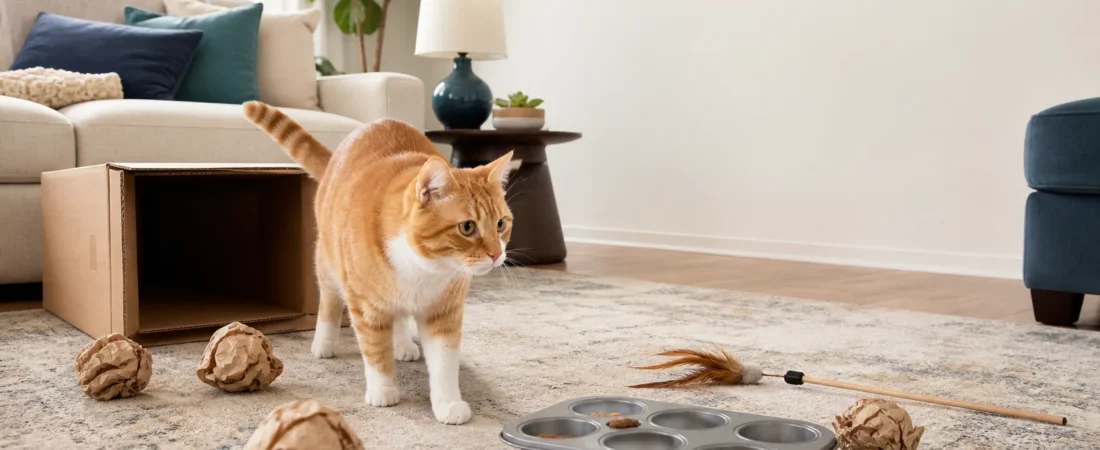
Indoor life protects cats from many outdoor hazards, but a safe home can still become predictable. The same hallway, the same bowl and the same toys in the same corner do not offer many opportunities to stalk, climb, search or choose. That is where enrichment helps.
You do not need to rebuild your living room or entertain your cat every minute. A few small changes—food hidden in easy places, a box with two exits, a better window spot and short interactive play—can make an ordinary day more interesting.
The ideas below use inexpensive household materials, but “DIY” does not mean risk-free. Supervise new activities, remove loose strings and small parts, and stop if your cat chews or swallows the material.
Quick answer: Give an indoor cat at least one safe elevated resting spot, several short interactive play sessions, a simple food-search activity and access to scratching surfaces. Rotate activities so they stay novel.
What indoor cat enrichment should provide
Useful enrichment gives a cat ways to express normal behavior: hiding, watching, climbing, scratching, hunting, catching, eating and resting. Cats differ, so one cat may spend twenty minutes investigating a paper bag while another ignores it and waits for a wand toy.
The activity should create curiosity, not pressure. If a cat crouches, flattens their ears, lashes their tail or leaves, give them space. Enrichment works best when the cat controls whether to approach and when to stop.
1. Make a cardboard reach feeder
Stand several clean paper tubes upright in a shallow box and drop a few pieces of kibble into different tubes. The cat reaches in with a paw to move the food. Start with wide gaps and food near the top. Add more tubes only when the first version is easy.
Use part of the cat’s normal ration rather than extra calories. Avoid staples, tape inside the play area and tubes with glue or chemical residue. Remove the feeder if the cat tears and eats cardboard.
2. Build a box tunnel with two exits
Open the ends of two or three sturdy boxes and connect them side by side, creating more than one route out. Cut edges cleanly and remove staples and tape loops. Place one toy or a few treats inside and let the cat explore without being pushed in.
Two exits matter in a multi-cat home because a single entrance can allow one cat to block another. Keep the tunnel wide enough for the largest cat to turn comfortably.
3. Turn breakfast into a small hunt
Divide a measured portion of food among several shallow dishes or safe puzzle locations around one room. The first time, keep everything visible. Later, place a dish behind a chair leg or on a stable low shelf.
Make sure every portion is found and eaten. Cats can become unwell if they do not consume enough food, so a food hunt should never make a reluctant eater miss meals. Ask your veterinarian before changing feeding routines for a cat with a medical condition or prescription diet.
Some links below are affiliate links. As an Amazon Associate, TailSprig Living may earn from qualifying purchases, at no extra cost to you.
Quick product comparison
Two easy ways to add daily play
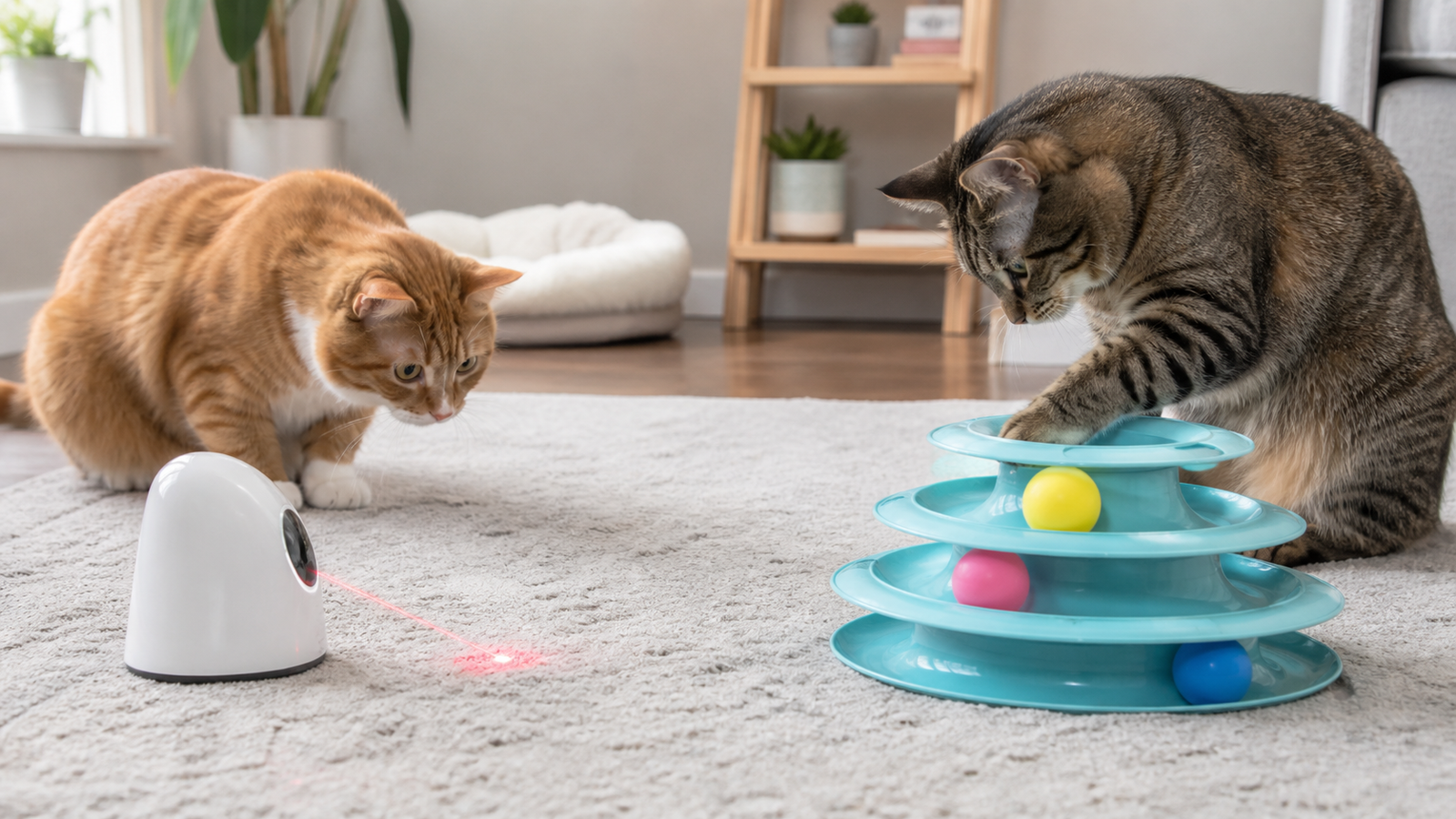
Use the chase toy for a short hunt–catch routine and the track toy for supervised batting sessions.
Best for motion-activated chase play
Potaroma Smart Sensor Cat Laser Toy
Check current details on Amazon
A motion-activated moving-light toy that creates varied chase sessions for indoor cats.
Check first: Use short supervised sessions, avoid shining the light into eyes and finish with a catchable toy or treat.
For supervised batting play
Catstages Tower of Tracks
Check current details on Amazon
A multi-level rolling-ball toy for batting, tracking and repeat play.
Check first: Check the base stability and inspect balls and tracks regularly. No toy is indestructible; supervise and remove it if damaged or parts separate.
Amazon prices and availability can change. Check the current size, materials, seller and return terms before ordering.
4. Create a crinkle-paper search tray
Place clean, plain packing paper loosely in a low-sided box and sprinkle a few treats on top. Your cat can sniff and paw through the paper. Keep the first layer shallow so nothing feels trapped.
Do not use plastic packing peanuts, foil, shredded ribbon or scented paper. Supervise cats that chew paper and remove the tray immediately if pieces are swallowed.
5. Add a safe window-watching station
Set a stable chair, cat tree or properly installed window perch near a closed, secure window. Add a non-slip mat or washable blanket. Outdoor movement provides visual stimulation without requiring a screen or video.
Never rely on a loose insect screen to prevent a fall. The ASPCA recommends snug, sturdy screens and warns that childproof window guards do not protect cats because they can slip through.
6. Rotate toys instead of displaying all of them
Choose four or five toys for the week and put the rest away. Include different actions: a ball to chase, a kicker to hold, a toy mouse to carry and a food puzzle. Swap the group every few days.
Novelty can renew interest in toys the cat already owns. Inspect everything during rotation. Discard cracked plastic, exposed stuffing, stretched elastic and loose feathers.
7. Make a vertical route
Cats often value height as much as floor space. Create a gradual path from a low stool to a stable shelf or cat tree. Cover slippery surfaces with non-slip material and leave enough room for the cat to turn.
Anchor tall furniture according to its instructions. Do not create a route that ends near breakable objects, a hot appliance or an open window. Older cats may need shorter steps or ramps.
8. Use a muffin tin as a beginner puzzle
Place kibble in several cups of a clean muffin tin. Leave most cups open and cover one or two with lightweight balls too large to swallow. The cat moves a ball to reach the food.
Use a non-slip mat under the tray. If the noise of a metal tin worries your cat, choose a silicone version or start with an egg carton only under close supervision.
9. Play a complete hunt-catch-eat sequence
Move a wand toy like prey rather than waving it in the cat’s face. Let it hide, pause, dart and occasionally become easy to catch. Finish by allowing a successful grab, then offer a small food reward or meal.
Put the wand away after play. String, ribbon and elastic can cause serious injury if swallowed. Aim for several short sessions rather than one exhausting marathon, and adapt the speed to the cat’s age and mobility.
10. Offer a paper-bag hideout
Remove the handles from a plain paper grocery bag and place it on its side. Add a familiar toy or blanket. Many cats enjoy the sound, shape and temporary hiding place.
Never leave handles attached, and avoid plastic bags. Replace the bag when it becomes wet, torn into small pieces or so crushed that the cat could become tangled.
11. Teach a target touch
Hold a spoon or small target a few inches from the cat. When they sniff or touch it, mark the moment with a quiet “yes” and offer a tiny treat. After several repetitions, move the target slightly to one side.
This is a gentle way to add problem-solving and can later help guide a cat onto a scale, into a carrier or toward a resting mat. End after a few successful repetitions.
12. Create a calm sensory station
Not all enrichment needs to be active. Set up a quiet resting area with a soft washable bed, a scratching surface and the option to hide. Keep it away from loud appliances, litter boxes and busy doorways.
You can occasionally add a cat-safe scent item, such as a small amount of catnip or silvervine, if your cat responds well. Avoid essential oils and heavily perfumed cleaners; many concentrated oils can be unsafe around cats.
A simple enrichment schedule for busy people
Consistency matters more than complexity. Try this repeatable routine:
- Morning: feed part of breakfast in a simple puzzle or two visible hiding places.
- Midday: leave a safe window seat, box tunnel and two rotated solo toys available.
- Evening: five to ten minutes of interactive wand play, followed by food.
- Twice a week: introduce one changed box layout, scent search or target-training session.
- Weekly: inspect toys, wash food puzzles and rearrange only one element at a time.
Keep the basic resources—food, water, litter, safe resting places—predictable. Enrichment adds choice; it should not make essentials hard to find.
Product ideas worth comparing
DIY projects are useful, but washable commercial items can be safer and easier for repeated use. These are sensible Amazon-search starting points:
- Catit Senses 2.0 Digger or a similar beginner food-search toy.
- Trixie Cat Activity Fun Board for several puzzle styles in one washable base.
- Potaroma Smart Sensor Cat Toy for short, supervised chase sessions.
- A stable cat tree with wall-anchor hardware for vertical space.
- A washable lick mat or slow feeder made for cats for wet food.
- A sturdy tunnel with more than one opening for exploration and play.
Check dimensions and materials rather than relying on star ratings alone. Start with easy access to food, supervise strings and moving parts, and return an item that shifts, cracks or frustrates your cat.
Signs an activity is too difficult
Enrichment is not supposed to test whether a cat is clever. Make the task easier if the cat paws frantically, bites the object, vocalizes repeatedly, walks away after a few seconds or stops eating.
For a puzzle feeder, reveal more food and remove covers. For a vertical route, lower the step. For interactive play, slow the toy and allow more catches. A confident first experience makes future sessions easier.
What not to use in DIY cat toys
Avoid unattended string, yarn, thread, dental floss, rubber bands and ribbon. Small bells, beads, buttons, foil balls and broken plastic can be swallowed. Do not use containers that held cleaners, medication or toxic substances.
Laser pointers can create a chase without a physical catch. If you use one, never shine it into eyes and finish by directing the cat to a real toy or food reward. Many homes can simply skip the laser and use a wand toy instead.
Multi-cat homes need more than one good spot
One amazing perch or one puzzle may become a resource that a confident cat controls. Provide several separated resting areas, scratching surfaces, water stations and play opportunities. Watch for quiet blocking—one cat sitting in a doorway or staring another away from a resource.
Offer individual play when possible. The shy cat may become much more engaged when the bolder cat is in another room.
When to speak with a veterinarian
A sudden loss of interest in play, reduced appetite, hiding, aggression or changes in litter-box habits can signal pain or illness. Do not assume a new toy will solve a sudden behavior change. Contact your veterinarian.
If boredom-related behavior continues despite a safe routine, a qualified feline behavior professional can help you assess the environment and interactions in the home.
The takeaway
Good indoor cat enrichment is a collection of small, safe opportunities: look from above, hide without being trapped, hunt a toy, work gently for food and rest without interruption. Begin with one food activity and one play activity, then keep the ideas your cat actually chooses.
Sources and further reading
- ASPCA, “Feline DIY Enrichment.”
- ASPCA, “High-Rise Syndrome: Lifesaving Tips for Cat Parents.”
- VCA Animal Hospitals, “Cat Behavior and Training: Enrichment for Indoor Cats.”
- VCA Animal Hospitals, “Feline Environmental Needs Guidelines.”
Pet-care information on TailSprig Living is educational and does not replace advice from your veterinarian or a qualified behavior professional.