
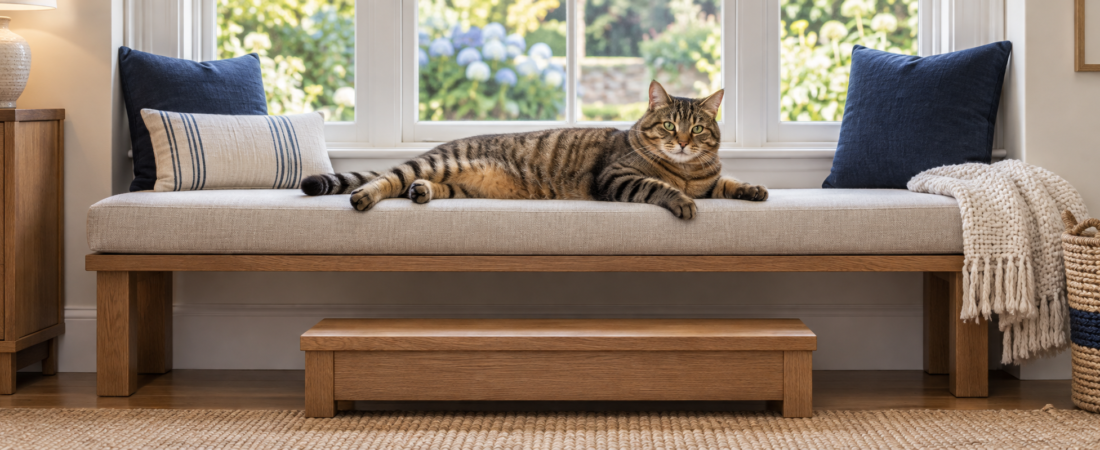
A large cat can make a perfectly good-looking window perch feel surprisingly small. The problem is not always the advertised weight limit. A perch may technically support a cat’s weight while still being too shallow for a stretched-out nap, too flexible underfoot or poorly matched to the window.
The best cat window perch for a large cat is therefore not one universal model. It is the option that gives your individual cat enough usable resting space, stays level under a moving load, fits the mounting surface and offers a sensible route up and down.
Before comparing products, record your cat’s current weight, notice how much space they use while resting and measure the window itself. If a second cat may join them, plan for the combined load rather than assuming the perch will remain a one-cat seat.
For the broader measuring and installation process, start with our guide to measuring and setting up a cat window perch safely.
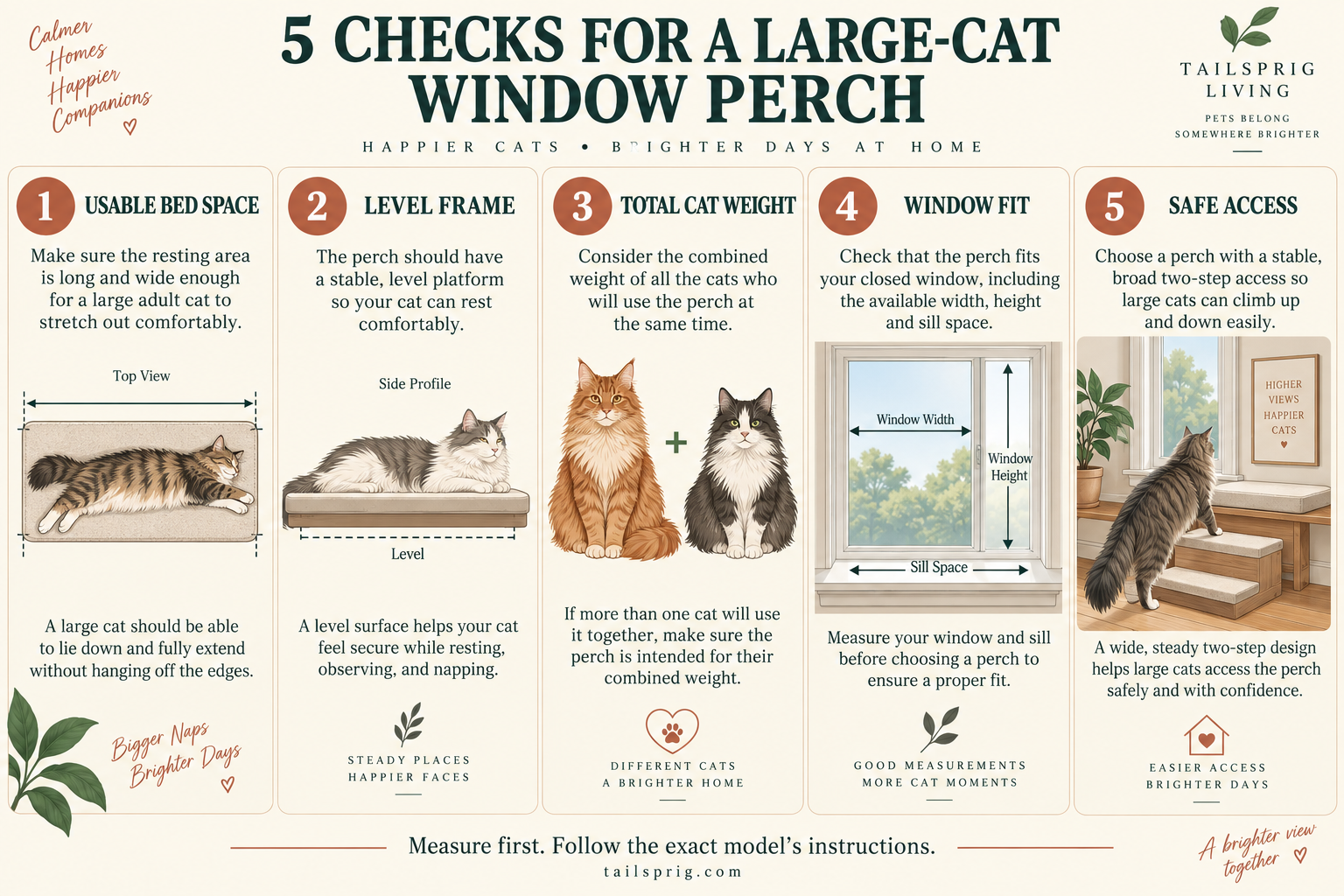
Quick answer: For a large cat, compare the usable sleeping surface, frame rigidity, manufacturer-stated capacity, mounting requirements and access route together. A large capacity number cannot compensate for a cramped bed, incompatible glass, an unsuitable sill or an awkward landing.
Affiliate disclosure
The Amazon link in this article is an affiliate link. As an Amazon Associate, TailSprig Living may earn from qualifying purchases, at no extra cost to you.
Compare the named size and mounting instructions before ordering. The K&H links lead to manufacturer specifications; they are not Amazon offers.
What “large enough” actually means
“Large cat” is not a precise shopping measurement. Two cats of similar weight may use a perch very differently. One may curl into a compact ball, while another sleeps fully stretched out or turns around several times before settling.
Look at the space your cat naturally occupies while relaxed. Compare that resting footprint with the product’s usable sleeping surface, not just its widest outside measurement. Frames, brackets, raised bolsters and attachment hardware can make the overall product dimensions much larger than the space where a cat can actually lie.
Also consider how the bed behaves near its edges. A deep fabric hammock may feel comfortable to one cat but unsteady to another. A rigid platform may provide firmer footing for a large or older cat, provided its surface is not slippery and the mount fits correctly.
Measure the load, the cat and the window
Before shopping, write down three sets of information.
1. Your cat’s size and resting habits
Record:
- your cat’s current weight;
- whether they curl up or stretch out;
- how much space they use when resting comfortably;
- whether they prefer a firm platform or a flexible bed;
- whether another cat is likely to join them.
If two cats may use the perch together, add both weights. Treat the manufacturer’s stated capacity as an upper limit, not proof that every installation below that number will be secure.
2. The mounting area
For a suction-mounted perch, measure the clear glass rather than the outside trim. Check for divided panes, textured glass, privacy film, cracks, condensation and anything else that could interfere with the specified mounting surface.
For a sill-supported model, measure:
- usable sill depth;
- sill thickness;
- the gap below or behind the sill;
- nearby trim;
- window handles;
- clearance for blinds and curtains;
- the space needed to open and close the window.
A no-drill label does not prove that a product fits every sill or leaves no marks.
3. The route up and down
A secure bed is only part of the setup. A large cat landing near one edge can place a sudden load on the frame and attachments. Plan where your cat will jump from, where their paws will land and how they will get down.
Kittens, senior cats and cats with reduced mobility may benefit from a lower position, stable intermediate step or nearby anchored cat tree. If a cat suddenly becomes reluctant to jump, appears stiff or shows signs of pain, ask your veterinarian for advice.
Five things that matter more than a headline capacity
1. Usable sleeping surface
Compare the actual resting area with your cat’s relaxed body size. Look beyond the overall package dimensions.
A wide platform can still feel cramped if cables, bolsters or frame pieces reduce the usable area. A surface that is long enough but too narrow may make turning around difficult.
2. Frame rigidity
The frame should remain level and controlled when weight is applied where the cat will actually step. A listed capacity does not tell you how much the fabric sags or how the platform behaves when weight shifts toward an edge.
Do not infer rigidity from product photos. Check the frame material, joint design and manufacturer instructions, then test the assembled perch only as directed.
3. Capacity with a sensible margin
Choose a manufacturer-stated capacity above the total expected load, including a second cat. Avoid treating that number as a complete safety guarantee.
The window condition, mounting accuracy, frame, attachments and the force of a jumping cat all affect the finished setup.
4. Mount compatibility
A strong frame cannot correct an incompatible mount.
Suction cups need the type and amount of glass specified by the manufacturer. Sill-supported models need compatible sill dimensions and solid contact points. Hooks, pressure pads, adhesive strips and screws each have different installation limits.
5. Safe access and maintenance
A perch should allow a cat to enter, turn and leave without squeezing past cables or jumping toward a slippery surface.
Removable, washable covers are useful, but also check whether approved replacement covers, cups or hardware are available. A worn attachment should be replaced with a compatible part rather than patched with tape or improvised knots.
Which mounting style works best for a large cat?
Suction-mounted perches
A suction-mounted perch uses very little floor space and can provide an open view. It requires smooth, clean, intact glass with enough uninterrupted area for every attachment.
This style can work for a large cat when the exact product, total load, glass and maintenance requirements all match. Inspect every cup and attachment regularly. Textured glass, divided panes, film, residue, cracks and recurring condensation can make a window unsuitable.
Sill-supported or bracketed perches
A sill-supported model transfers more of the load to the sill, frame or wall below the window. A rigid version may feel steadier to a cat that dislikes a flexible hammock.
Compatibility is the trade-off. Hook depth, sill thickness, pressure-pad position, wall gap and window operation all need to match. “No drill” should not be interpreted as universally damage-free or automatically approved for a rental home.
Stable furniture beside a window
For an incompatible window, a stable bench, low cabinet or properly anchored cat tree can provide a view without mounting a bed to the glass.
Use a non-slip resting surface and make sure the furniture cannot tip or shift when the cat jumps. This can be a practical fallback, but it should not become an improvised stack of boxes or lightweight furniture.
For more ways to build variety into an indoor cat’s environment, see our practical indoor cat enrichment ideas.
Large-cat window perch comparison
This comparison uses current manufacturer specifications and exact model matching, not TailSprig hands-on testing. A missing numeric capacity is marked as unknown and keeps that model out of the large-cat shortlist. “Best” here means the strongest specification-and-fit match for a particular window and cat, not a universal performance ranking.
| Model | Bed / stated limit | Mount |
|---|---|---|
| K&H EZ Mount | 23 × 12 in cover; up to 50 lb | Suction cups |
| Zakkart Natural/Gray L | 24 × 15 in bed; up to 40 lb | Sill hooks |
| K&H Kitty Sill, unheated | 24 × 14 in surface; up to 40 lb | Adhesive or screws |
Specifications were reviewed on September 14, 2026. Check the current model instructions before ordering. A stated capacity is a limit, not a guarantee for every window or installation.
Which option is worth a closer look?
K&H EZ Mount, SKU 100553011: a documented suction candidate
Fit and care: Cord-free suction mount and steel frame; smooth unobstructed glass at least 29.5 × 14 × 9.5 in; not for textured glass, divided panes or louvered windows; machine-washable cover; clean glass and cups monthly; folds for blinds.
The EZ Mount is worth considering when you want a cord-free entry and have the uninterrupted glass space listed above. Its 23 × 12-inch cover is shallower than the other two surfaces, so compare it with your cat’s resting footprint. Use the K&H specifications to confirm installation and maintenance requirements.
Zakkart Windowsill Perch with Bolsters, Natural/Gray L
Fit and care: Suction-free hook-on mount; slot at least 0.5 in deep; 0.08-in hook thickness; sill no deeper than 9 in; hardwood/metal frame; cold wash and low tumble dry.
The Zakkart is the suction-free option to compare when your window has the required slot and compatible sill depth. The bolstered bed offers a defined resting edge, but the usable space still needs to fit your cat. The linked Natural/Gray L version on Amazon is the 24 × 15-inch model; do not transfer those measurements to the larger variant.
K&H Kitty Sill, unheated gray, SKU 100546595
Fit and care: Minimum 2-in sill; hook-and-loop adhesive or included screws; adhesive must cure 24 hours; cover washes cold/gentle and line-dries or dries without heat.
The unheated Kitty Sill provides a foam-supported oval resting surface on a compatible sill. Compare the installation method as carefully as the bed size: adhesive can affect finishes, while screws make a permanent change. The manufacturer’s page and instructions cover both heated and unheated versions, so select the unheated gray model discussed here.
How to test the setup before your cat uses it
Follow the product instructions from the beginning. Do not assemble a perch from photos or substitute unknown hardware.
Once installed:
- Inspect the glass, sill, frame, fasteners, cables and fabric.
- Apply gentle downward pressure with your hands while watching every attachment.
- Follow the manufacturer’s testing procedure.
- Perform a static load check only when the manufacturer describes or permits one, using the stated method and limits rather than an improvised procedure.
- Remove the test load and inspect everything again. A successful static check does not prove that the setup will resist the sudden force of a cat jumping onto one edge.
Sliding, lifting, creaking, sagging, twisting or visible frame movement needs to be resolved before a cat uses the perch.
Do not lift a nervous cat onto a flexible or moving bed. Let them investigate voluntarily. A familiar washable cover, a few treats or a short toy session nearby can make the area more inviting without forcing contact.
Window and screen safety
A perch does not turn an open window into a secure cat balcony.
The ASPCA warns that falls can happen when cats focus on birds or other outdoor activity, and it recommends snug, sturdy window screens. It also cautions that childproof window guards may leave gaps a cat can pass through. Keep the window closed unless the opening has a secure pet-safe solution designed for that specific window. ASPCA
Before installing a perch:
- do not use cracked or damaged glass;
- check that the window closes and locks normally;
- make sure a screen is secure and cannot pop outward;
- keep blind cords, curtain loops and dangling strings out of reach;
- avoid positioning the perch where the cat will press against a weak screen.
Special considerations for senior and multi-cat homes
A high capacity alone does not make a perch accessible.
For a senior cat or a cat with reduced mobility, consider a lower mounting position, stable intermediate step and supportive surface. Keep the landing area clear and non-slip. Sudden reluctance to jump, stiffness or pain deserves veterinary attention.
In a multi-cat household, total the weight of every cat likely to share the perch. Also consider whether the surface gives both cats enough room to turn and leave without conflict.
Providing more than one desirable resting place gives cats more choice and may reduce competition for a single window seat. Ohio State’s Indoor Pet Initiative notes that multiple perches can offer different viewing options, while VCA recommends vertical spaces that are suitable for the cat’s size. Ohio State Indoor Pet Initiative, VCA Animal Hospitals
Frequently asked questions
What size window perch does a large cat need?
There is no universal size. Compare the usable sleeping area with the space your cat occupies while resting naturally. Confirm that the cat can lie down, turn and stand without being crowded by the frame, cables or bolsters.
Is a 40- or 50-pound capacity enough?
A manufacturer-stated rating above the expected load is important, but it is only one part of the decision. You must also check sleeping dimensions, frame rigidity, mount compatibility, glass or sill condition and the way the cat lands.
Can two cats share one window perch?
Only consider it when the manufacturer permits the combined load and the usable surface gives both cats enough space. Add both weights, leave a sensible margin and provide another desirable perch so neither cat has to compete for the only seat.
Are suction-cup perches appropriate for large cats?
They can be appropriate when the exact product supports the expected load and every cup is mounted to compatible, intact glass according to that model’s instructions. For example, K&H excludes textured glass, divided panes and louvered windows for its EZ Mount model. Regular inspection and cleaning remain necessary. Stop using the perch if any attachment moves or loses its seal. If a model has no current first-party capacity, do not assume it is suitable for a large cat or a multi-cat load.
Is a rigid platform always better than a hammock?
No. Some cats enjoy a flexible bed, while others avoid movement under their paws. Large or older cats may find a supportive platform easier to enter and stand on, but the frame, surface, mount and access route still need to fit the individual cat.
What if my cat refuses to use the perch?
Check for wobble, deep sagging, an awkward entry height or a slippery landing. Add an easy route and a familiar cover, then reward voluntary investigation. Do not force the cat onto the perch.
Can I leave the window open behind the perch?
Keep the window closed unless the opening has a secure barrier designed for pets and that exact window. An ordinary insect screen is not fall protection. Childproof guards can leave gaps a cat can pass through.
The takeaway
The best cat window perch for a large cat is not the one with the biggest number in the product title. Start with your cat’s resting space and total expected load, then compare frame behavior, mounting requirements, window compatibility and the route up and down.
Verify the exact model, follow its instructions, test the completed setup gradually and keep inspecting it after your cat starts using it. A perch earns its place in the home by fitting the cat and the window—not by looking convincing in a product photo.
Sources and further reading
- TailSprig: How to Choose and Set Up a Safe Cat Window Perch
- Ohio State University Indoor Pet Initiative: Perches
- VCA Animal Hospitals: How to Make Vertical Space for Cats
- ASPCA: High-Rise Syndrome Safety Tips
- K&H Pet Products: EZ Mount Cat Window Perch
- Zakkart: Windowsill Perch with Bolsters
- K&H Pet Products: Kitty Sill and Thermo-Kitty Sill
Pet-care information on TailSprig Living is educational and does not replace advice from your veterinarian.