
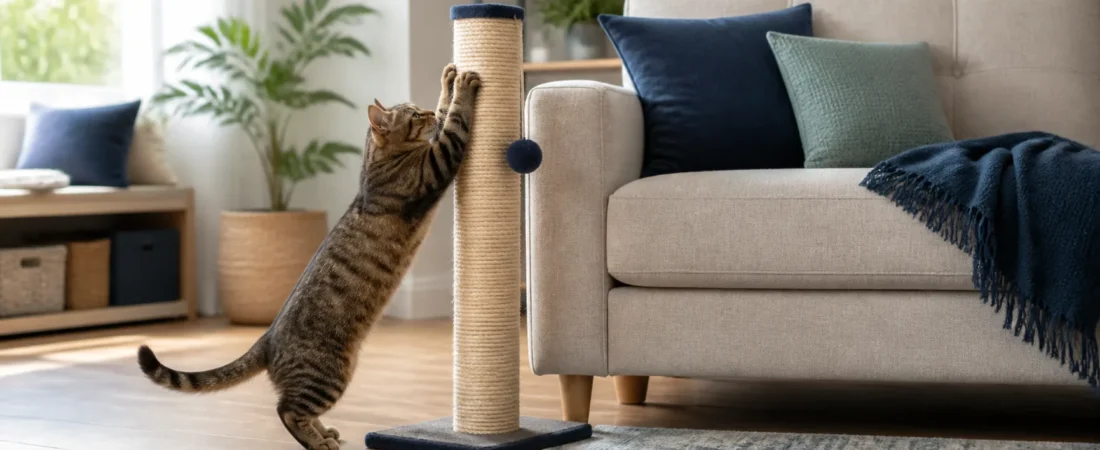
Quick answer: To stop a cat scratching the sofa, do not try to stop scratching itself. Place a stable scratching post directly beside the damaged area, match the surface and direction your cat already prefers, make the sofa temporarily less rewarding, and reward every voluntary use of the new scratcher. Punishment usually adds stress without teaching a useful alternative.
Scratching is normal cat behavior. Cats scratch to stretch, maintain their claws, leave scent and visual marks, and communicate in shared spaces. Your sofa is attractive because it is sturdy, prominent and often located near the people your cat values. A successful plan respects those needs while redirecting them to something that works for both of you.
First, learn what your cat likes about the sofa
Before buying a post, observe the scratching for two or three days. Does your cat stand upright and rake downward, or crouch and scratch a horizontal edge? Is the target fabric coarse, smooth or tightly woven? Does scratching happen after waking, during play, when you arrive home or near a doorway?
These details are a free product test conducted by your cat. A vertical sofa corner suggests a tall vertical post. Scratching the seat or rug may call for a horizontal cardboard pad. Some cats enjoy sisal rope, while others prefer cardboard, wood or fabric. Offering two different surfaces is often more effective than assuming every cat wants the same tower.
Why punishment does not solve sofa scratching
Yelling, spraying water or startling a cat may interrupt one moment, but it does not remove the need to scratch or show the cat where scratching is welcome. The cat may simply wait until you leave. Punishment can also make your presence unpredictable, which may increase stress and create other behavior problems.
Never hold a cat against a post and drag their paws over it. The ASPCA specifically advises against forcing the paws onto a scratcher. Let the cat investigate and choose the surface. Your role is to make the desired choice easy and worthwhile.
Step 1: Put the scratcher beside the exact problem spot
Placement matters more than aesthetics at the beginning. Put the post directly in front of or beside the sofa corner your cat uses. A beautiful scratching tree across the room is not an equivalent choice if the sofa marks a socially important pathway or resting area.
If your cat scratches after waking, add a second scratcher near the sleeping spot. If scratching happens near a doorway or window, provide an option there too. In a multi-cat home, spread scratchers across different rooms so one cat cannot easily guard them all.

Step 2: Choose a post that does not wobble
A vertical post should be tall enough for a full-body stretch and stable enough to resist a strong pull. If it rocks, tips or slides, the sofa will still feel safer. A wide base helps, as does placing the post against a wall while the habit develops. Horizontal pads should also stay put; add a non-slip mat underneath if necessary.
Match the orientation first, then the material. For a cat who uses both sofa arms and carpet, provide one vertical and one horizontal option. Variety is useful, but you do not need to fill the house with equipment. Begin with the strongest clues your cat has already given you.
Step 3: Make the new scratcher interesting
Invite exploration without forcing contact. Run a wand toy past the scratcher so your cat reaches and places paws on it naturally. Sprinkle a small amount of catnip or silver vine if your cat responds to it. You can also rub a clean cloth along your cat’s cheek and then wipe the cloth on the base, adding a familiar scent.
Reward the earliest useful behavior: looking at the post, approaching it, touching it and finally scratching. A tiny treat delivered immediately after the behavior makes the connection clearer. Keep sessions short and playful rather than turning the post into a training assignment.

Step 4: Make the sofa temporarily less satisfying
Protect the damaged area while the new habit develops. Depending on the fabric, a fitted cover, furniture protector or pet-safe double-sided tape may help. Always test any adhesive on a hidden area first. The goal is a temporary change in texture—not to frighten or trap the cat.
Keep the acceptable scratcher immediately next to the protected area. Blocking the sofa without providing an alternative often moves the behavior to another chair. Once your cat reliably chooses the post for several weeks, move it only a few inches at a time toward the location you prefer.
Step 5: Reward the behavior you want to see again
When your cat uses the scratcher, quietly mark the moment with praise and deliver a treat or start a short game. Timing matters: reward within a second or two, not several minutes later. You do not need to reward forever. Once the scratcher has become a well-established part of the cat’s territory, occasional rewards are enough.
If you catch sofa scratching in progress, avoid shouting. Calmly guide attention toward a toy near the scratcher, then reward use of the correct surface. If redirection repeatedly fails, improve the post’s placement, stability or texture rather than increasing punishment.
Step 6: Add play and predictable routines
Scratching can increase when a cat is bored, excited or stressed. Schedule one or two short interactive play sessions each day, especially before times when sofa scratching usually happens. Let your cat stalk, chase and catch the toy, then finish with a small meal or treat.
Provide elevated resting places, hiding spots and a predictable routine. In a multi-cat home, separate key resources such as food, water, litter boxes, resting areas and scratchers. These changes do not replace a well-placed post, but they can reduce the pressure behind repeated marking.
Should you trim your cat’s claws?
Regular claw trimming can reduce the damage from sharp tips, but it will not remove the need to scratch. If your cat accepts paw handling, trim only the clear hooked tip and avoid the pink quick. Introduce the process gradually with treats. Ask your veterinarian or groomer to demonstrate if you are uncertain.
Soft nail caps are sometimes used as a temporary management tool, but fit and replacement matter and not every cat tolerates them. Discuss them with your veterinarian. Declawing is not a simple nail trim; it removes part of each toe and should not be treated as a furniture solution.
A practical seven-day reset plan
- Day 1: Observe when, where and how your cat scratches. Measure the height of the marks.
- Day 2: Place a stable, appropriately sized scratcher directly beside the target.
- Day 3: Add a short wand-toy game around the post and reward voluntary contact.
- Day 4: Protect the sofa surface with a fabric-safe temporary barrier.
- Day 5: Add a second orientation or material if the first post is ignored.
- Day 6: Review the locations. Move ignored scratchers closer to waking, play or doorway areas.
- Day 7: Keep what works. Continue immediate rewards and leave the sofa protected while the habit strengthens.
Common mistakes that slow progress
- Placing the post out of sight: Scratching has a social and territorial purpose, so prominent locations often work best.
- Choosing a short or wobbly post: Your cat cannot fully stretch and may not trust the surface.
- Offering only one texture: A cat who prefers cardboard may ignore sisal, and vice versa.
- Removing the post too soon: Keep it beside the sofa until the new pattern is well established.
- Rewarding too late: The treat needs to follow the scratching behavior almost immediately.
- Expecting zero scratching: The realistic goal is scratching in suitable places.
When scratching may need professional help
Contact your veterinarian if scratching increases suddenly, is accompanied by overgrooming, skin changes, appetite changes, hiding, aggression or litter-box problems. Pain, anxiety and medical issues can alter behavior. A qualified feline behavior professional can help when careful environmental changes have not worked or when conflict exists between cats in the home.
Frequently asked questions
How long does it take to stop sofa scratching?
Some cats switch within days when the new post closely matches their preference and sits beside the sofa. Others need several weeks. Keep the setup consistent and change one variable at a time so you can tell what is helping.
Does catnip work for every cat?
No. Sensitivity to catnip is inherited, and young kittens may not respond. Try play, treats or silver vine if appropriate, but the post’s location and stability are usually more important than scent.
Can I move the scratching post later?
Yes, after your cat uses it reliably. Move it only a few inches every few days. If the cat returns to the sofa, move the post back and wait longer before trying again.
Pet care note: This guide offers general educational information. Sudden behavior changes, signs of pain or severe anxiety should be discussed with your veterinarian.
Find more practical ideas in our Cat Care library and Pet-Friendly Home guides.
Sources reviewed
- ASPCA: Destructive Scratching
- International Cat Care: Scratching on furniture and carpets
- VCA Animal Hospitals: Scratching Behavior in Cats