
Last reviewed: September 2026
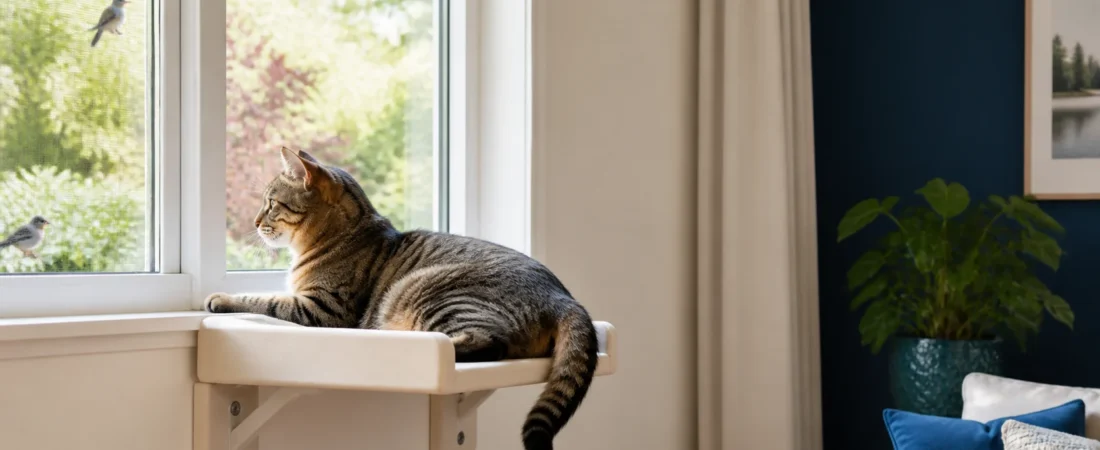
A cat window perch can turn an unused pane into a sunny nap spot and a front-row seat for birds, leaves and neighborhood activity. The useful part is not the novelty. It is giving an indoor cat safe height, a clear view and another place to rest without taking over the floor.
The safest perch is the one that fits three things at the same time: your cat, your window and the way your household uses that window. A suction model can be convenient on smooth glass, while a sill-supported perch may suit a large cat, a renter or a window that opens often.
Use this guide to measure first, choose a compatible mounting style, install it carefully and check it regularly. Product photos are helpful, but your own measurements and the manufacturer’s instructions decide whether a perch belongs in your home.
Why cats enjoy a window perch
Cats often seek elevated resting places because height can provide a wider view and a little distance from household traffic. A window adds changing visual stimulation and a warm place to rest. Ohio State’s Indoor Pet Initiative and VCA both include perches or vertical space among useful parts of an enriched indoor environment.
A window seat is only one enrichment station. It works best alongside interactive play, scratching surfaces, hiding places, scent activities and more than one comfortable resting option. See our practical indoor cat enrichment ideas and our guide to redirecting sofa scratching without punishment.
Before you buy: a 60-second fit check
Do this quick check before opening Amazon or comparing styles. It prevents the most common problem: buying a good perch that simply cannot fit the cat or the window.
- Record your cat’s current weight and add the weight of any second cat that may join them.
- Notice whether your cat curls tightly or sleeps fully stretched out.
- Measure the clear width and height of the glass, not the outside trim.
- Measure the usable sill depth and any gap or lip required by a sill-mounted model.
- Check clearance for blinds, curtains, handles and normal window operation.
- Plan a non-slip route up and down, especially for kittens, senior cats and cats with reduced mobility.
Keep these numbers beside you while shopping. A claimed weight capacity does not tell you whether the platform is deep enough, whether the frame will feel rigid under a landing cat or whether the mount fits your exact window.
Step 1: Measure the cat, not just the window
Start with body size and sleeping posture. A compact cat who curls into a tight ball may be comfortable on a shallow fabric hammock. A long or heavy cat that stretches out needs a wider, deeper sleeping surface and usually benefits from a rigid frame.
Treat the manufacturer’s capacity as a limit, not a guarantee that every installation will be safe. Glass condition, sill construction, mounting accuracy and a cat jumping onto the edge all matter. If two cats could use the perch together, add both weights and leave a sensible margin.
For a senior cat, comfort also includes access. A lower perch, a stable step or a nearby cat tree can reduce the need for a long jump. Look at the landing route in both directions and remove slippery mats or sharp-edged furniture below it.
Step 2: Choose the right mounting style
Suction-cup window hammock
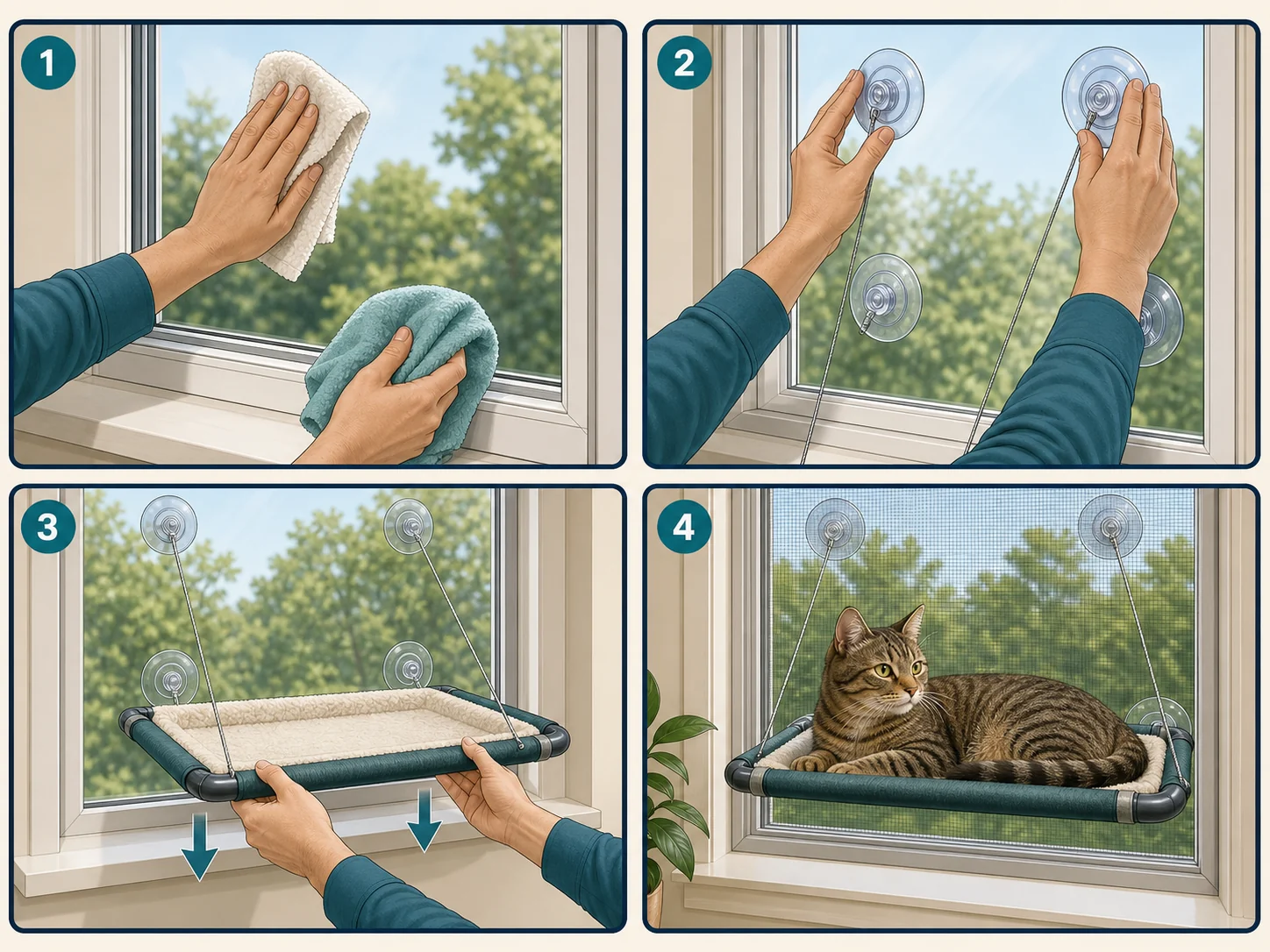
This style attaches directly to the glass and uses very little floor space. It is best suited to smooth, clean, intact glass with enough uninterrupted area for every cup. Follow the product instructions for cleaning, warming or positioning the cups and repeat the maintenance schedule.
Avoid attaching cups over textured glass, privacy film, cracks, heavy residue or a pane that regularly collects condensation. A seal can weaken slowly, so a firm first tug is not a substitute for routine inspection.
Sill-mounted or bracketed perch
These models transfer more of the load to the sill, frame or wall below the window. They can feel more rigid and are useful when suction cups are unwanted. The trade-off is compatibility: hook depth, sill thickness, the wall gap below the sill and window operation all have to match the product.
For renters, “no drill” does not automatically mean “no marks” or “approved by the lease.” Check whether the design uses pressure pads, hooks, adhesive strips or optional screws, and confirm what your rental agreement allows.
Furniture beside the window
A stable bench, low cabinet or anchored cat tree can provide the view without attaching anything to the glass. This is often the simplest answer for unusual window shapes or households that open and close the window every day. Use a non-slip mat and keep the furniture stable enough that it cannot tip when the cat jumps.
Some links below are affiliate links. As an Amazon Associate, TailSprig Living may earn from qualifying purchases, at no extra cost to you.
Two window perches to compare
These are starting points, not universal winners. Measure first and check the exact model, installation instructions and return terms before ordering. The K&H link below leads to its manufacturer specifications; it is not an Amazon offer.
| Model | What stands out | Check before buying |
|---|---|---|
| AMOSIJOY Cordless Cat Window Perch | Cordless suction-cup format with an open entry path. | Confirm the exact current dimensions, weight rating and required glass area on the listing. |
| K&H EZ Mount Cat Window Perch — manufacturer specifications | The manufacturer lists a steel frame, a removable 23 × 12 inch sleeping surface and support up to 50 lb. | Requires at least 29.5 × 14 × 9.5 inches of smooth, unobstructed glass. Clean the glass and cups monthly. |
Step 3: Make the window itself safe
An open window with a loose insect screen is not a safe cat balcony. Cats can lean, pounce or lose their footing while focused on something outside. The ASPCA warns that ordinary childproof window guards may still leave openings a cat can slip through.
Before mounting the perch, inspect the whole window area:
- Confirm that the window closes and locks normally.
- Do not use cracked or damaged glass.
- Make sure any screen is strong, correctly seated and unable to pop outward.
- Position the perch so the cat is not encouraged to press against a weak screen.
- Tie blind cords, curtain loops and dangling strings safely out of reach.
- Keep the window closed unless you have a secure solution designed for pets and that opening.
Step 4: Prepare the mounting surface
For suction cups, clean both the glass and cups according to the manufacturer’s directions. Dust, grease, cleaner residue and condensation can reduce grip. Dry everything fully unless the instructions specifically say otherwise.
Press each cup separately and inspect the seal around the entire edge. Support cables should be straight, correctly attached and unable to catch a paw. Check that the frame joints, fabric sleeve and fasteners are fully seated.
For a sill-supported model, make sure every bracket or pressure pad contacts a solid surface. Tighten only as directed. Over-tightening can damage trim or distort a frame, while a loose bracket can shift when the cat lands.
Step 5: Test before your cat uses it
Do not install a perch and immediately place your cat on it. First apply gentle downward pressure with your hands while watching every attachment point. Then follow the manufacturer’s testing instructions. If a safe static test is allowed, use a stable object rather than an animal and never exceed the product or window limits.
Leave the test in place long enough to reveal a slowly weakening seal, then remove it and inspect the cups, cables, frame, fabric and sill again. Any sliding, lifting, creaking or visible movement means the setup needs to be corrected before use.
Step 6: Introduce the perch without forcing your cat
Let your cat discover the new seat. A familiar washable cover, a few treats or a short wand-toy game nearby can make the area interesting. Create an easy route and keep the first sessions quiet.
Do not lift a nervous cat onto a moving hammock. If the surface shifts under their feet, they may avoid it later. Reward voluntary investigation and make sure the cat can leave whenever they choose.
Special considerations for large, senior and multi-cat homes
For a large cat, compare the usable sleeping surface with the cat’s relaxed body length, not just the overall product dimensions. Look for a frame that remains level when weight is placed near the edge and a cover that does not sag so deeply that standing up becomes difficult.
For a model-by-model fit comparison, see how to choose a window perch for a large cat.
For senior cats or cats with arthritis, a high capacity alone is not enough. Add a stable intermediate step, keep the resting surface supportive and choose a height that avoids a hard landing. Ask your veterinarian about sudden reluctance to jump, stiffness or pain.
In a multi-cat home, provide more than one desirable resting place. One cat should not be able to guard the only window seat or force another cat into a risky jump.
Small apartments and renter-friendly setups
A folding cat window perch can save floor space, but only if it still allows blinds and the window to work safely. Keep the approach clear and avoid placing food, water and litter in the same crowded corner.
If suction cups or drilling are not suitable, place a sturdy bench or cube shelf beside a closed, securely screened window. Add a non-slip mat and washable bed. Anchor tall or narrow furniture using a method permitted by the lease and the product instructions.
Avoid improvised elevated platforms made from thin cardboard, stacked boxes or unknown hardware. A renter-friendly solution should reduce risk, not move it from the glass to unstable furniture.
Cleaning and weekly safety checks
Hair, skin oils and household dust collect around a window seat. Wash removable fabric on the recommended cycle and let it dry completely before reassembly. Wipe rigid parts with a pet-safe cleaner and remove any residue.
Check the setup weekly, and more often after large temperature changes, heavy condensation or moving the perch:
- suction-cup edges for lifting, bubbles or sliding;
- cables for fraying, twisting or loose connections;
- fabric for stretched seams or torn attachment points;
- brackets, screws and pressure pads for movement;
- the window, glass and screen for damage;
- the floor and landing route for new obstacles.
Replace damaged parts with approved replacements. Household tape, extra knots and improvised fasteners can hide a failing part without restoring the original strength.
Common cat window perch mistakes
- Buying from the photo: a perch shown with a kitten may be too shallow for an adult cat.
- Using only the weight rating: capacity does not confirm that the platform fits the cat or the mount fits the window.
- Skipping maintenance: suction cups and glass collect residue even when they look clean.
- Trusting a loose screen: an insect screen is not fall protection.
- Forcing the first use: a frightened cat may avoid a perch that moved under them.
- Ignoring the route down: a safe bed with a slippery landing is still an incomplete setup.
Frequently asked questions
Are suction-cup cat window perches safe?
They can be appropriate on compatible, undamaged glass when installed and maintained exactly as directed. The product, the mounting surface and the total load all matter. Inspect the cups regularly and stop using the perch if any attachment moves.
How much weight should a cat window perch hold?
Choose a manufacturer-stated capacity above the total expected load, including a second cat. Capacity alone is not enough, so also check platform dimensions, frame rigidity, glass or sill requirements and the way your cat jumps onto the perch.
Can renters use a cat window perch without drilling?
Yes, some models use suction cups, sill hooks, pressure supports or nearby furniture. However, no-drill does not guarantee no marks or lease approval. Confirm the mounting method, window compatibility and rental rules before installation.
What if my cat refuses to use the new perch?
Make the route easier, add a familiar cover and reward voluntary investigation. Do not force the cat onto it. Some cats dislike flexible hammocks and prefer a firm platform or stable piece of furniture beside the window.
Can I leave the window open behind the perch?
Only with a secure pet-safe barrier designed for the specific opening. Do not rely on a standard insect screen, a childproof guard with large gaps or your cat’s balance.
The takeaway
A useful cat window perch begins with measurements, not a shopping photo. Match the platform to your cat’s body, the mount to the window and the height to a safe route up and down. Install it exactly as directed, test it gradually and keep checking it after the novelty wears off.
Sources and further reading
- Ohio State University Indoor Pet Initiative: Perches
- VCA Animal Hospitals: How to Make Vertical Space for Cats
- ASPCA: High-Rise Syndrome Safety Tips
- K&H Pet Products: EZ Mount Cat Window Perch specifications
Pet-care information on TailSprig Living is educational and does not replace advice from your veterinarian or a qualified behavior professional.