
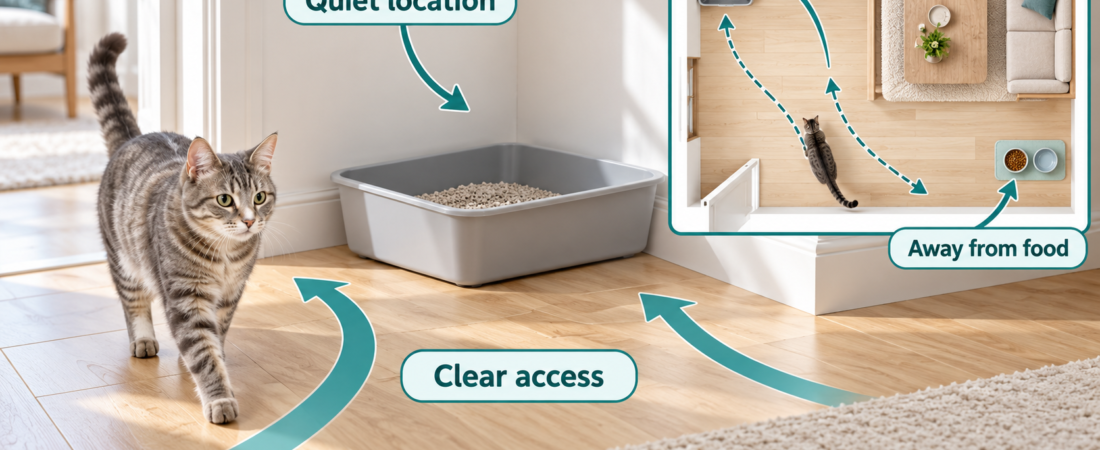
The empty corner is not always the useful corner. A litter box can fit neatly beside the washing machine and still leave a cat dealing with sudden noise, a closed door, or another pet waiting in the doorway.
Start with the route your cat takes to the tray. Then consider the room. A location that works through an ordinary busy evening is more useful than one that looks tidy in a photograph.
Quick answer
Choose a quiet, consistently accessible place away from food and water. Leave room to approach, turn and leave without another pet blocking the route. In a home with several cats, distribute trays rather than lining them up together. AAHA recommends multiple convenient locations and an additional box beyond the number of cats as a general starting point. AAHA litter-box guidance.
Compare the places you actually have
Make a shortlist of two or three possible locations. For each, answer these questions during normal household activity:
• Does someone close the door during showers, calls or bedtime?
• Is this where people rush past with bags or laundry?
• Could a dog or another cat sit across the only approach?
• Can you reach the tray easily enough to notice and remove waste?
• Will you still accept this location when visitors arrive?
The last question is practical: a tray that repeatedly gets hidden away for guests has no dependable home. Write down the compromise for each space before buying furniture to conceal it.
Bathroom: check the door first
A bathroom may be workable if the tray has enough space and access remains dependable. Walk through the household routine: a person taking a long shower, a guest closing the door, and someone cleaning the floor. If any of these cuts off the only tray, the location needs a different arrangement.
Do not squeeze the box between the toilet and a cabinet simply because the outside dimensions fit. Your cat also needs usable space. Keep bathroom products stored securely, and consider how you will scoop without moving the tray every time.
Laundry room: listen while appliances run
Visit the proposed location while the washer is spinning, rather than judging it while the room is silent. Cats Protection advises keeping trays away from noisy appliances and busy routes. Food, water and sleeping areas should also be separate from the toileting area. Cats Protection toileting advice.
A separate quiet part of the home may be the better compromise if the only laundry-room space sits directly beside a machine. There is no need to make a cat tolerate that location just because it is convenient for cleaning.
Living room or bedroom: plan around daily use
Sketch the room with the door, main walking route and candidate tray position. Add the furniture as it is used: chair pulled out, wardrobe open, laundry basket on the floor. This simple check often exposes a route that looked clear until the room became occupied.
Treat a decorative screen as something to evaluate, not an automatic improvement. Check whether it narrows the approach or makes the tray harder to inspect. A concealed setup still has to work for the cat and for daily cleaning.
For wider layout ideas, see our pet-friendly home guide. Keep feeding, play and resting choices separate from the toileting decision.
Several cats: count locations as well as boxes
Three trays side by side do not provide three different routes. AAHA emphasizes accessible boxes in different locations, particularly in multicat homes, with a way out when needed. Watch the approach as well as the tray: a cat lingering in a doorway can make another cat hesitate without an obvious fight.
Older cats and kittens may need easier entry. Box design, cleanliness and individual preferences matter alongside location; rearranging the room cannot compensate for every difficulty with the tray itself. AAHA guidance.
Keep a useful observation note
Record the location, whether its door stayed open, unusual noise and any hesitation you noticed. Separate observations from guesses. “Waited outside the bathroom while the door was shut” is more useful than “hates the new litter.” Bring those details to a veterinary appointment if toileting changes.
Do not punish accidents. A new pattern of house-soiling deserves veterinary advice rather than an assumption that the cat is being difficult. If your cat repeatedly strains and passes little or no urine, seek emergency veterinary care immediately: a urinary blockage is life-threatening. Cornell Feline Health Center.
Before you buy an enclosure
Measure the usable inside space and the approach, not just the cabinet exterior. Check access for scooping and whether the intended box fits with room to use it. Do not choose a smaller tray simply to make a decorative cabinet work. An enclosure is optional; its appearance does not establish that your cat will like it.
Start with the location audit. It costs nothing and gives you a clearer shopping brief: the available footprint, access needs and cleaning routine. This guide offers general information and does not replace veterinary advice.
The educational illustration is AI-generated and does not depict product testing.
An optional open tray to compare
As an Amazon Associate I earn from qualifying purchases. The following is an affiliate link; we may earn a commission if you buy through it.
The Petmate open tray below is the Large, grey version, not the Giant model. Compare the usable interior and entry height with your cat before buying: the word “Large” is not a guarantee of a suitable fit. Petmate lists several different sizes. Inspect the tray on arrival, and keep a suitable existing box if no change is needed. We have not personally tested this product.
