
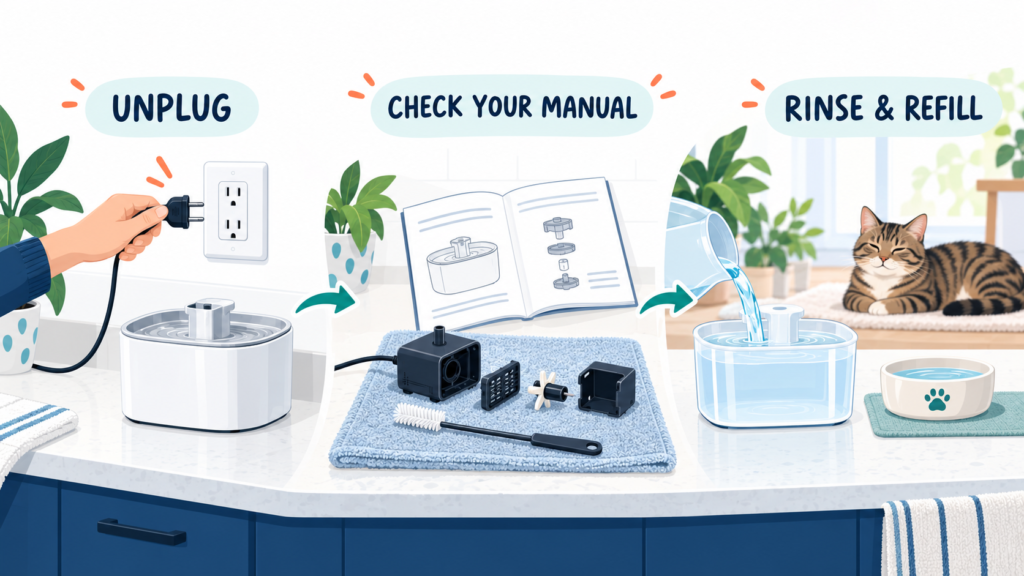
The top of a cat water fountain can look presentable while the parts underneath still need attention. If you have been washing the bowl and swapping the filter, the next place to check is the water path: the tube, cover and any removable pump parts.
Start with the manual for your exact model. Some fountains have a small submersible pump that comes apart for cleaning. Others keep the motor in a separate base that must stay out of water. A cleaning video for a similar-looking fountain is not enough to tell you which parts you can wash.
The routine below helps you organise the job without treating every fountain as the same machine. Keep another source of fresh water available while it is apart.
1. Set up before you empty the fountain
Put a clean water bowl somewhere your cat can reach comfortably. Cats Protection recommends keeping clean, fresh water available at all times. Choose a spot away from food and the litter tray. For a multi-cat home, our guide to introducing cats explains why separate resources matter.
- Find the model name and its current cleaning instructions.
- Unplug or disconnect the fountain as the manual directs, with dry hands.
- Keep the mains plug, adaptor and other non-washable electrical parts away from the sink.
- Lay out a towel or tray for the small pieces; do not leave them over an open drain.
- Take a quick photo before removing covers or seals so you can see their original position.
The Catit Stainless Steel Flower Fountain manual instructs owners to disconnect power before maintenance. Do not handle a running pump to investigate a noise. If a cord or electrical part is damaged, stop using the fountain and contact the manufacturer.
2. Sort the parts by how they can be cleaned
Empty the old water, then remove only the parts the manual identifies as removable. Keep the filter separate from the pieces you will wash with soap.
| Part | Check before cleaning |
|---|---|
| Bowl, lid and water tube | Approved cleanser and whether each part is dishwasher-safe. |
| Removable submersible pump | Which covers and impeller pieces you may remove; the model’s washing method. |
| Separate motor base | Whether it is wipe-only and must stay out of water. |
| Filter and pre-filter | Rinsing instructions and the replacement schedule for each type. |
For example, PetSafe’s Viva instructions permit washing certain fountain parts in the dishwasher but exclude the pump and adaptor. “Dishwasher-safe fountain” does not mean that every component can go in.
3. Check the hidden pump parts
For a conventional removable Drinkwell pump, PetSafe’s pump-cleaning guide shows the faceplate, stator and impeller coming out. The impeller is the small rotating piece inside. Follow that guide only if it matches your pump; do not pry open a sealed motor or force an unfamiliar cover.
- Remove the user-removable cover and inner pieces in the order shown in the manual.
- Inspect the intake, the impeller and the cavity it sits in, rather than brushing only the outer casing.
- Use the approved cleaning method and a suitably small brush to reach the accessible recesses.
- Rinse the washable parts thoroughly and refit each piece before returning the pump to the fountain.
PetSafe’s Drinkwell disassembly instructions call for cleaning inside the pump whenever the fountain is taken apart for cleaning. They also warn against bleach and harsh chemicals. White mineral deposits are a reason to consult the model’s descaling instructions; do not borrow an overnight soak or chemical mixture from a comment thread.
A different design needs a different approach. On the newer Catit Easy Clean Flower Fountain, the reservoir lifts off the motor base. Catit says to use a dry or lightly damp cloth on a visibly dirty base or pump, never a wet cloth, and never to submerge it. Its removable impeller and reservoir parts are cleaned separately. Do not apply the submersible-pump example above to that base.
4. Wash the bowl and deal with the filter separately
Use a soft cloth or sponge and the cleanser approved for the bowl, lid and other washable parts. Check under the lid and around the water outlet as well as the surface your cat drinks from. Catit’s Mini Flower cleaning guide advises against abrasive sponges and aggressive detergents.
Remove visible hair and debris before reassembly. If a narrow water tube is removable, clean it by the method in its manual rather than assuming that a quick rinse reaches the whole inside.
Keep soap away from filters where the instructions prohibit it. The Viva cleaning guide distinguishes between rinsing or replacing its filters and washing the fountain parts. Use the correct replacement for your model, and follow any instructions for rinsing or soaking a new filter before fitting it. A new filter does not replace cleaning the rest of the fountain.
5. Rinse, reassemble and check the flow
- Rinse the washable pieces until no soapy residue remains.
- Check your reference photo and manual when refitting covers, tubes and seals.
- Refill to the model’s indicated water level before reconnecting power.
- Make sure the mains plug and adaptor are dry and the fountain is stable before switching it on.
- Watch the fountain run briefly; check for leaks, an unusual noise or an absent water flow.
The Catit Stainless Steel Flower manual warns against allowing its pump to run dry. If your fountain does not work normally after reassembly, switch it off before checking water level, component placement and obstructions. Contact the manufacturer if the problem remains; do not improvise an electrical repair.
How often should you clean it?
Use your model’s schedule, with earlier attention when you see residue or debris. There is no single interval for every design: Catit Mini Flower guidance calls for removing and cleaning its pump every two weeks, while PetSafe Viva guidance gives a two-to-four-week fountain-cleaning interval and notes that multi-pet households may need more frequent cleaning.
Write the full-clean and filter-replacement dates separately. Between those jobs, make checking the water level and visible condition part of your daily routine. If you keep topping up a fountain that needs washing, the cleaning task is still waiting.
A useful tool for the small spaces
This article contains affiliate links. As an Amazon Associate, we earn from qualifying purchases.
The PetSafe Drinkwell Fountain Cleaning Kit, CKPH is an optional three-brush set to compare for Drinkwell fountains. PetSafe identifies a small brush for the pump cavity and different brush sizes for awkward areas. Check the fit against your own fountain; a brush should reach the opening without being forced. It does not change which parts are washable or make a different brand compatible.

Common questions
Can I clean it without taking the pump apart?
An outside rinse cannot show you the condition behind a removable cover. If your model has user-removable pump parts, follow its disassembly instructions. If it has a sealed base, follow the wipe-only instructions instead; opening it is not a cleaning shortcut.
Can I put the whole fountain in the dishwasher?
Only if its instructions explicitly permit every part you plan to load. Remove excluded components first. A washable stainless-steel tray tells you nothing about the motor, filter housing or adaptor.
What if my cat still ignores the fountain?
Keep a clean bowl available rather than making the fountain the only choice. Some cats prefer moving water, but preferences vary. Cats Protection advises veterinary assessment if your cat suddenly drinks more or less than usual; changing fountains is not a substitute for that check.
For the surrounding setup, see our litter box placement guide so the water station stays separate from the tray and its approach route.