
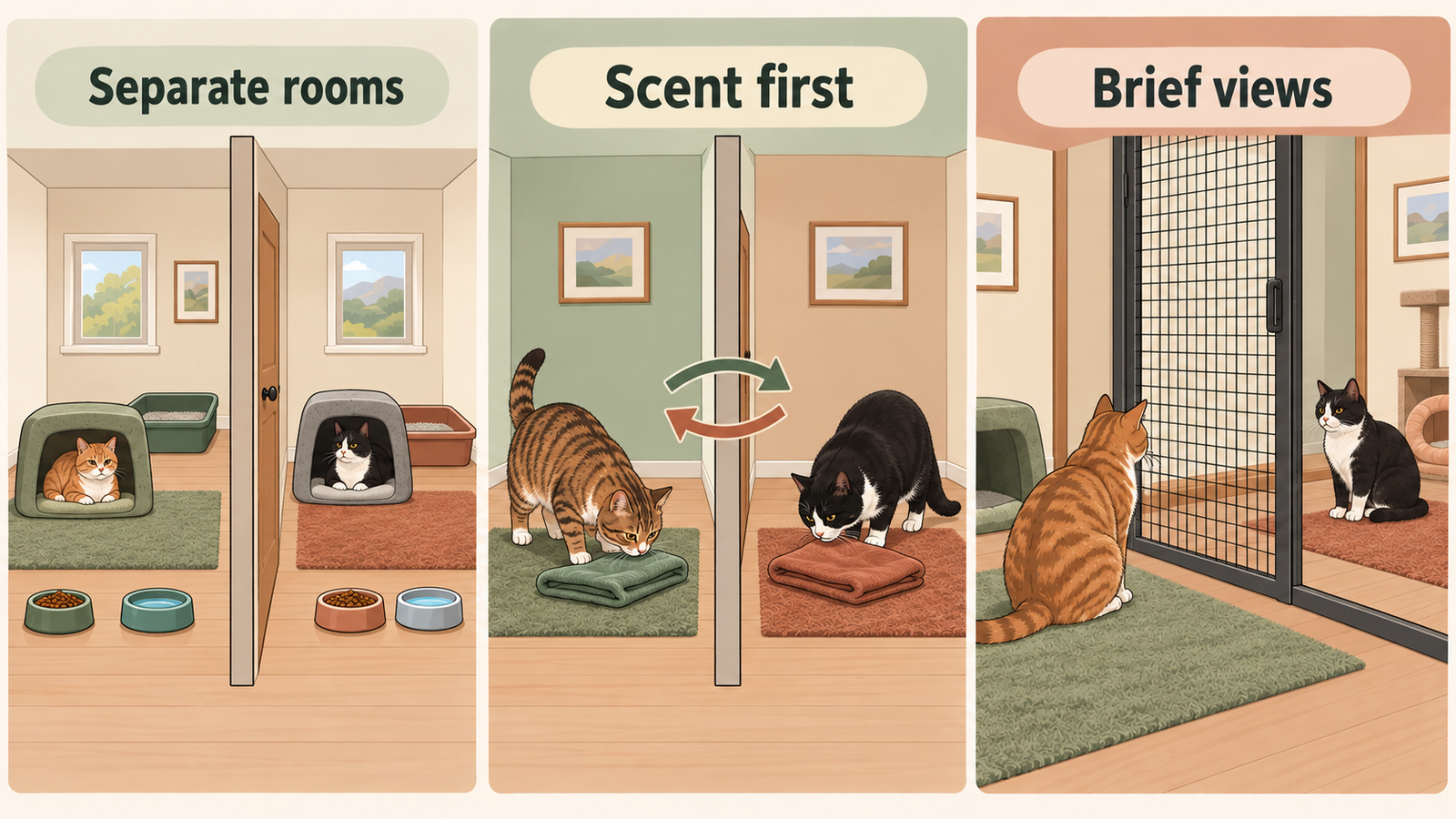
Bringing home a second cat changes more than the head count at dinner. Your resident cat suddenly has unfamiliar smells in familiar places, while the newcomer is trying to work out where it is safe to sleep, eat and hide.
Start with separate living areas, then work through scent, sight and short supervised meetings. Move forward when both cats seem comfortable at the current stage. A calendar cannot tell you when they are ready: introductions may take days, weeks or months. UC Davis explains why gradual introductions and repeated steps matter.
1. Give the newcomer a room with a closed door
Prepare a quiet room before the cat arrives. Include food, water, a litter box, somewhere to hide, a bed, toys and a scratching surface. Keep the litter box away from the food and water. Let the resident cat keep its familiar routine elsewhere, and spend time with each cat individually.
An open carrier can serve as a retreat if the cat already feels comfortable using it. Our cat carrier training guide covers making that space inviting without chasing a cat into it. The San Francisco SPCA introduction guide recommends a small, quiet room and time to settle before direct meetings.
Make the door routine practical, too. Tell everyone in the home which room is occupied. Check where each cat is before entering or leaving, rather than discovering an accidental meeting in the hallway.
2. Introduce the smell before the other cat
Swap bedding the cats have rested on. Another option is gently collecting cheek or forehead scent with a cloth when a cat welcomes that contact. Leave the scented item where the other cat can investigate or ignore it. Do not press it against the cat’s face.
Watch the response. Sniffing and moving on is different from avoiding the area, growling or remaining fixed on the item. Keep the cats apart while they become familiar with the smell. Cats Protection describes scent swapping as a stage before visual contact.
When both cats are settled, let the newcomer explore another part of the home while the resident cat is securely elsewhere. Return them to their separate areas afterward. This gives each cat a chance to explore without a face-to-face encounter, as outlined in the HumanePro introduction factsheet.
3. Use a secure barrier for brief visual meetings
A closed door is useful at first. Later, a suitable glass or mesh barrier can let cats see each other while remaining physically apart. Begin at a distance where both can stay comfortable, with the option to move away. Offer separate treats or play rather than arranging a nose-to-nose inspection.
Check the barrier before relying on it. A gate that either cat can climb over, squeeze through or knock aside is not doing the job. Keep the solid door available, and supervise these sessions. RSPCA guidance places positive visual contact before supervised physical contact.
If a cat stays at the far end of the room, that is useful information. Give it the distance it needs; do not carry it toward the other cat to make the meeting happen.
4. Let body language decide the next step
A hiss is a reason to pay attention, not an invitation to punish the cat or push the session onward. Look at the whole interaction and how each cat recovers.
| What you see | What to do |
|---|---|
| Both cats can look away, move about and choose to leave | Keep the meeting easy; consider another short session at the same stage. |
| Flattened ears, a crouched body, puffed fur or an arched back | End the session and give them separate space. |
| Chasing, cornering, lunging or repeated fixation | Stop direct contact and return to an easier stage; seek help if it continues. |
The National Animal Welfare Trust advises ending introductions when cats show distress and using short sessions before extending their time together.
5. Keep the first shared-room visits easy to end
Once visual sessions are going well, try a brief supervised visit with room to move away. Keep access to the newcomer’s retreat open. Give each cat its own activity and space; a single toy between them may create competition.
End while the visit is still manageable, then separate the cats again. Increase time gradually after repeated comfortable meetings. Continue separating them when you cannot supervise until their interactions are reliably comfortable. RSPCA’s staged approach above includes short periods of unsupervised access only after positive supervised contact.
Never put your hands between fighting cats. Cornell’s veterinary guidance warns that this can cause serious injury and discusses barriers for separating cats. If you cannot intervene safely, get professional help with a separation plan before another meeting.
6. Keep separate resources after the introductions
Check the routes to food, water, beds and litter boxes. One cat sitting in a doorway can make a resource difficult for the other cat to reach, even without a fight. Put supplies in different locations so sharing one spot is not compulsory. For litter boxes, HumanePro recommends one per cat plus one extra. See our litter box placement guide for checking the room and the route.
This article contains affiliate links. As an Amazon Associate, we earn from qualifying purchases.
If you need another open tray, the Petmate Open Cat Litter Box, Large, Grey is one option to compare. Check its current size and entry height against your cat’s needs before ordering. It is a tray for the room setup, not a way to resolve conflict. The manufacturer’s basic litter box page is a separate product reference.

If the introduction stalls
Go back to the last stage that both cats handled comfortably. A quiet day apart is more useful than repeatedly testing a tense meeting. Keep a short record of the stage, distance and each cat’s response so you can explain the problem clearly.
Contact your veterinarian for aggression, injuries, changes in appetite or litter box habits, or ongoing distress. Medical problems can contribute to aggressive behavior; Cornell recommends veterinary assessment rather than assuming the issue is purely behavioral. A veterinarian can also help you find qualified behavior support.
Aim for cats that can use their home comfortably. Friendship may develop, but it is not guaranteed. Cats Protection cautions that some cats do not accept another cat in their home, even when owners would like them to become companions.