
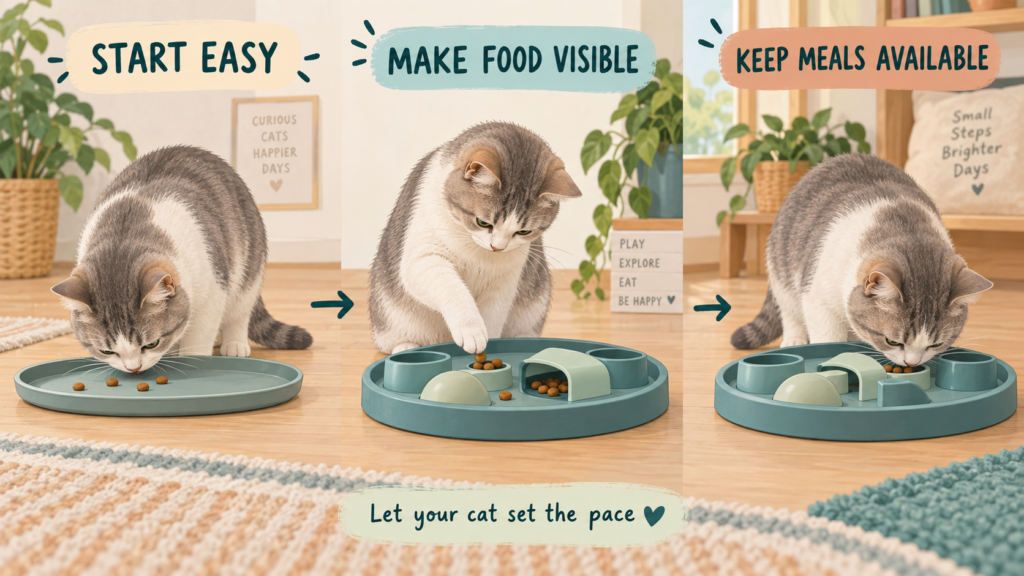
Your cat can smell the kibble in a new puzzle feeder, but instead of reaching for it, they sit beside it and wait. That first attempt can look like rejection. It may simply mean the food is harder to reach than your cat knows how to manage.
Make the first session almost as easy as eating from a dish. Offer a small amount of familiar food, show how it becomes accessible and keep the rest of the meal straightforward. A puzzle should give your cat something interesting to do while still letting them eat enough.
Quick start: Use the easiest setting, leave food visible and supervise. International Cat Care recommends keeping some of the daily food allowance in a bowl during the introduction. Never make hunger the price of learning.
Choose a feeder your cat can use comfortably
Look at the action the puzzle asks for. A rolling dispenser needs a nudge; an activity board asks for a paw or nose movement; a wet-food feeder usually involves licking. A tall tower and a shallow tray can both be food puzzles, but they ask different things of the cat.
Cat Adoption Team distinguishes moving and stationary food puzzles and chooses feeding methods around each cat’s needs. For a first attempt, choose easy access, secure assembly and a surface that stays steady. Check that openings do not trap a paw or head and that parts are not loose or damaged.
- Use a feeder designed for the food you already offer; do not change the diet just to suit a toy.
- Choose access your cat can manage without climbing, balancing or reaching awkwardly.
- Read the manufacturer’s setup and cleaning instructions before adding food.
- Keep the first puzzle simple rather than choosing the most complicated design.
If your cat has a medical condition, a prescribed diet or difficulty eating, ask your veterinarian how puzzle feeding fits their care. FelineVMA’s Cat Friendly Homes guidance recommends veterinary advice when feeding or intake is a concern.
1. Take the puzzle food from the normal allowance
Measure the day’s planned food first, then set aside a small portion for the puzzle. Keep track of food offered in the bowl, puzzle and training rewards together. Moving kibble to a toy does not make it an extra meal.
Try the activity around an ordinary feeding time, without delaying the meal to make your cat hungry. Use a food they already accept. If you use treats to spark interest, keep them within the feeding plan rather than repeatedly refilling the puzzle.
2. Let your cat find an easy reward
Place the feeder in a familiar, quiet feeding area. BC SPCA suggests using a little kibble around the feeder to connect the new object with food. Put a few pieces where they are obvious and easy to reach; leave covers open or use the widest approved openings.
Sit nearby without crowding your cat. Let them sniff, eat an exposed piece and decide whether to investigate again. Do not hold a paw against the puzzle or push their face toward it.
If they stare at the food, demonstrate one simple movement yourself: nudge a dispenser gently or move a slider so a piece becomes reachable. Let your cat eat that reward. You are showing the connection between movement and food, not demanding that they solve the whole device.
3. Stop while the attempt is still comfortable
TRIXIE recommends supervising introductions and watching for chewing or broken parts. Stay close enough to see what your cat actually does. Sniffing and one successful reach are useful first steps; emptying every compartment is unnecessary.
Finish if your cat walks away, becomes restless or repeatedly struggles without getting food. Make the next attempt easier. If they bite the device, pull pieces off or try to swallow material, stop using it and inspect it before offering it again.
Return inaccessible food to the usual dish so the planned meal is still available. Before clearing up, check what was eaten and what remains in the puzzle. Food disappearing from one compartment does not tell you how much the cat consumed.
4. Change one part of the challenge
Repeat an easy version until your cat can get food calmly without your help. Then adjust one feature: close one cover, narrow an approved opening or use a slightly less exposed compartment. Keep the location and food familiar while you test that change.
There is no deadline for moving up a difficulty level. A product’s beginner label does not guarantee a good fit for every cat. If the new version produces repeated failed attempts or less eating, go back to the last version that worked.
When the feeder gets ignored
| What you notice | Next thing to check |
|---|---|
| Sniffs food, then waits | Expose a piece; show a simple movement and offer easy access. |
| Paws but gets no food | Check the opening, kibble fit and difficulty setting. |
| The puzzle slides or tips | Check assembly and use a secure, level location. |
| Another cat takes over | Give each cat a separate, private feeding space. |
| Leaves food and refuses the usual dish too | Stop the activity and contact your veterinarian promptly. |
Cornell’s Feline Health Center advises prompt veterinary attention when a cat stops eating. Refusing normal food is not a training problem to wait out. Do not force-feed or keep increasing the puzzle challenge.
Keep cats and food routines separate
In a multi-cat home, one shared puzzle makes it hard to know who ate what. A confident cat may take over even when there is no obvious fight. Offer separate feeding spaces and watch each cat’s intake.
Cat Friendly Homes recommends distance and visual separation between feeding stations. Our guide to introducing cats explains how to plan separate resources when cats share a home.
An optional dry-food puzzle to compare
Some links below are affiliate links. As an Amazon Associate, TailSprig Living may earn from qualifying purchases, at no extra cost to you.
The Catit Senses Food Tree, model 43151, is one option for cats that are comfortable reaching with a paw. Catit describes it as a dry-food and treat feeder with an adjustable internal disc. It is an option to compare, not a necessary first purchase or a promise that your cat will use it.
Follow Catit’s assembly instructions and check that the cylinder, base and discs are secure. Start with the easiest approved opening and easy-to-reach food. Retain the bowl option during learning. Do not put wet food into a tower intended for dry food and treats.

Clean it before the next session
Remove uneaten food and inspect pockets, covers and joins. Follow the exact feeder’s cleaning instructions, rinse away cleanser and let parts dry before loading dry food again. Do not assume a washable feeder is dishwasher-safe.
For the Food Tree, Catit recommends disassembly and warm water, dishwashing soap and a soft sponge; abrasive sponges and aggressive detergents are excluded. If parts no longer fit securely after cleaning, resolve that before use.
If puzzle feeding is not your cat’s preferred activity, there are other ways to add interest. Our DIY indoor cat enrichment guide includes play, hiding and toy rotation. Keep meals reliable and choose an activity your cat can enjoy.