
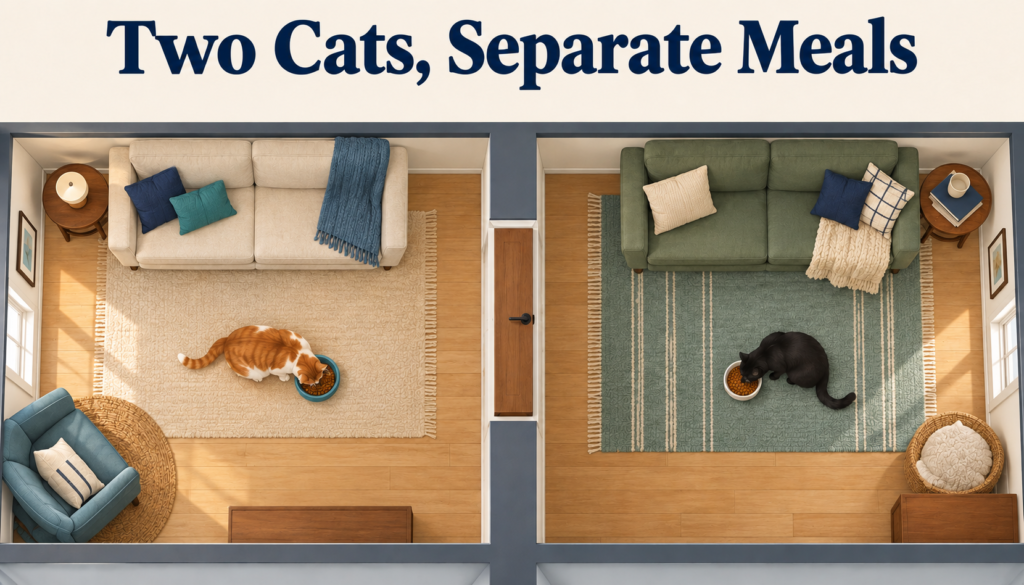
Educational AI illustration, not a measured room plan: separate comfortable rooms can protect each cat’s portion. Use another arrangement if a closed door causes distress.
Two full bowls can turn into one cat eating twice and the other walking away. Adding more food to the shared spot makes it harder to know who ate what. The useful change is to give each cat access to their own meal, at a pace they can manage.
Start with the bowls and rooms you already have. Watch what happens before buying a feeder: does the quicker eater switch bowls, wait beside the other cat, or take over after the slower cat leaves?
Quick Answer
- Place each cat’s usual portion in its own quiet feeding space. Start with bowls you already have.
- Watch who eats, how much is left and whether one cat guards a doorway or finishes the other’s food.
- Give the slower eater time. If a cat refuses food or appetite changes, contact your veterinarian promptly.
What You’ll Need
Separate bowls, two locations the cats can use comfortably, their usual portions and somewhere to note leftovers. If one cat has a prescribed feeding plan, follow the veterinary team’s instructions.
1. Check appetite changes before changing the routine
If a cat stops eating, contact your veterinarian promptly. Do not assume they are being stubborn or wait for hunger to teach them a new schedule. Cornell’s guidance on loss of appetite recommends immediate veterinary advice.
Also ask your vet about unexpected weight changes or new feeding difficulties. Keep prescribed diets with the cat they were prescribed for, as Cats Protection advises. If food contains medication and another cat gets into it, contact the prescribing veterinarian for advice; do not guess at a replacement dose.
This guide changes access to meals. Your vet should set any special diet, weight-management plan or medical feeding routine.
TailSprig Living · Amazon Idea List
My recommendations for a cat who enjoys a food puzzle
The indoor play collection includes a Catit Food Tree and Doc & Phoebe’s hunting feeders for dry food. Offer a familiar puzzle in one cat’s own feeding space. Keep the other cat out and make sure the intended cat eats. Ordinary bowls work for separate meals.
Affiliate link. As an Amazon Associate I earn from qualifying purchases.
See the food puzzles on Amazon2. Give the bowls separate locations
Put each bowl in a familiar, quiet area that its cat can reach comfortably. Two bowls touching on the kitchen floor still create one shared feeding spot.
The Feline Veterinary Medical Association’s feeding guide recommends distance and visual separation between feeding stations. A wall or solid piece of furniture can remove the direct view between them. There is no universal number of feet that suits every home.
A visual barrier does not stop a cat walking around it. If food is still being taken, you need supervision or a way to control access as well.
Keep food away from litter trays and place drinking water separately from food. Cats Protection’s feeding advice supports this arrangement. Our litter box placement guide helps you check that the new meal spot has not crowded a toileting area.
3. Try a supervised separate meal
Choose a time when you can watch both cats. Begin with their usual food rather than changing the location, diet and feeding equipment together.
- Prepare each cat’s own portion. Use the amount agreed with your vet or appropriate feeding instructions. Keep the bowls identifiable if the foods differ.
- Set up both eating spots before serving. Use comfortable familiar rooms or separate areas. Let each cat reach their place without being chased, dragged or held at the bowl.
- Protect the meal while they eat. A closed room can work if that cat is comfortable there. If closing the door causes distress, use another arrangement and supervise; an open doorway or visual screen alone will not prevent bowl switching.
- Watch the faster eater after they finish. Keep them from moving straight to the other bowl. Quietly manage access rather than scolding either cat or pulling them away mid-bite.
- Check the unfinished portion before the cats rejoin. Keep the slower cat’s remaining food protected for an appropriate later feeding opportunity. Do not leave it where the quicker cat can finish it.
Cats Protection’s feeding and obesity leaflet describes separate-room meals and removing accessible leftovers before cats rejoin. The point is to manage who can reach the food, not to make both cats finish simultaneously.
Do not keep a distressed cat shut away to complete the exercise. If neither cat can eat comfortably with the arrangements available, ask your veterinary team for help designing a workable routine.
Match the setup to the problem
| What you notice | First change to try | What to check next |
|---|---|---|
| The faster eater switches bowls immediately | Supervised meals in comfortable separate spaces | Whether the other cat can continue eating without interruption |
| The slower cat leaves and returns for small bites | Protected access across their feeding opportunities | Whether their remaining food stays available to them and is handled safely |
| Closing a door causes distress | A different familiar location with supervision | Whether you need professional help or selective-access equipment |
Looking around repeatedly, cautious approaches, flattened or sideways ears, and a crouched posture can indicate tension at meals, according to the FelineVMA feeding guide. A bowl becoming empty is not the only thing to check.
If the problem began when a new cat arrived, revisit the wider cat introduction plan. Meal management does not replace work on the relationship between the cats.
Leave room for the slower eater’s pace
A grazer may need several protected chances to eat. Do not impose a short meal deadline or abruptly remove their usual access just because it is easier to monitor two bowls at once.
Write down what you offer each cat and what remains. For example, note “own bowl partly eaten; other cat blocked from access” rather than “both bowls empty.” That record makes a feeding discussion with your vet more useful.
Food safety still matters. The FDA’s pet-food handling advice says to promptly refrigerate or discard unused or leftover canned and pouched food, and wash bowls and utensils after use. Follow the food’s storage instructions when planning later meals. A covered feeder is not a refrigerator.
When a microchip feeder is worth considering
Selective-access equipment may be useful when a cat needs protected feeding opportunities and you cannot supervise every one. Check the exact model’s operation, your cat’s microchip compatibility and its training process before buying.
One model to compare is the SureFeed Microchip Pet Feeder, distinct from the Connect version. Its manufacturer information describes a lid that opens for a registered pet’s microchip or compatible collar tag.
The manufacturer’s training instructions begin with an open lid, then introduce movement gradually as the cat becomes comfortable. During the first stage, the lid stays open: continue protecting the food from the other cat while training.
After setup, supervise actual meals and confirm that the intended cat eats comfortably and the other cat cannot gain access. Do not rely on a device alone to prove that a prescription diet or medicated meal reached the right cat.
The Amazon link below is for the standard, non-Connect SureFeed Microchip Pet Feeder (MPF001), selected as “Standard Version”. Check the model and included accessories before ordering. The manufacturer’s guide warns that selective access cannot guarantee exclusion of every other pet, so keep supervising meals and checking that the right cat gets the food.
The feeder card below contains affiliate links.

Check what changed
Keep a simple record:
- Each cat’s food offered and leftovers, rather than one combined household total.
- Any hovering, displacement or attempts to reach the other bowl.
- Whether the slower cat returns comfortably for their next feeding opportunity.
- Appetite or weight changes to discuss with your veterinarian.
You can offer a familiar easy puzzle feeder separately if your cat already enjoys it. It is an activity, not a barrier that protects the other cat’s dinner; do not make harder puzzles or hunger the price of eating.
Choose the arrangement by what you observe: both cats need comfortable access to their own food. If protected meals remain difficult, bring your notes to the vet and ask for a feeding plan that fits the cats and the home.
Printable checklist
Separate cat meals checklist
- Measure and label each cat’s usual portion.
- Choose two feeding spots away from the other cat’s approach.
- Watch who eats from each bowl.
- Give the slower cat time and record any leftovers.
- Call the veterinarian about food refusal or an unexplained change in appetite.
Frequently asked questions
What if one cat finishes first?
Keep the cats separate long enough for the slower eater to finish without pressure.
How do I know who ate?
Observe a separate meal and record each cat’s portion and leftovers.
Do I need a microchip feeder?
Try separate feeding locations first. A feeder is useful only if it addresses the access problem and the cat accepts it.
When is a feeding change a health concern?
If a cat refuses the familiar meal, contact your veterinarian promptly. A second cat taking the food does not explain every change in appetite.
Leave a Reply