
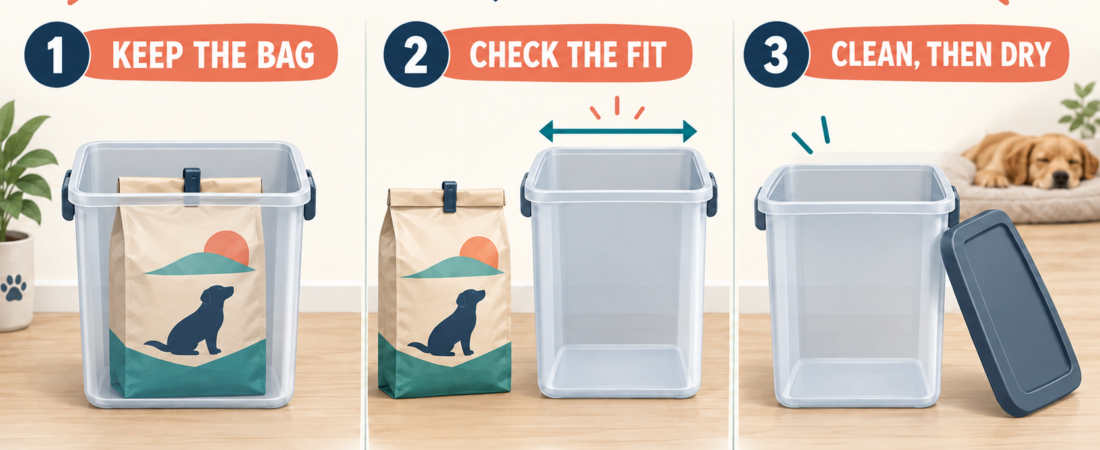
Keep the original bag, check its fit and clean the empty bin before refilling. AI-generated educational illustration.
A food bin can hold plenty of loose kibble and still be awkward to use with the original bag inside. The opening may be too narrow, the bag may catch on moulded corners, or the lid may not close without crushing its top. Those are worth checking before you buy another container.
For everyday dry dog-food storage, start with the food’s own packaging and directions. Purina’s storage guide recommends closing the original bag securely and putting it inside a suitable container. A tidy setup should also let you reach the food, read the current label and clean the empty bin.
Check the bag, not just the advertised capacity
Treat a capacity stated in pounds as information about the container, not a promise that your particular food bag will fit. Bag shape, the container’s opening and the space below the closed lid all matter. A round opening can be especially awkward for a wide, rectangular bag.
Before choosing a bin, check:
- The opening: can the filled bag pass through without tearing, spilling or being forced?
- The usable interior: do corners, wheels, hinges or an inner taper take up space?
- The lid: will it close normally with the bag’s top folded or fastened?
- Daily access: can you scoop from the bag, see its label and lift it out without struggling?
- Cleaning access: can you reach the bottom and corners, and inspect them while the bin dries?
If those details are missing from a listing, ask the seller or manufacturer for the relevant opening and interior dimensions. Compare them with the actual bag you normally buy. Exterior measurements alone cannot answer every fit question.
You can make a rough size check using the bag’s width and depth, but leave room for its shape to change when handled. That is a planning check, not a tested capacity formula. Do not force a bag into a bin that only works after you damage the packaging.
Set up a storage spot you can use consistently
Purina’s UK storage guidance recommends a cool, dry place away from heat, sunlight and moisture. Read your own food’s instructions too. A convenient corner beside a hot appliance or a damp utility-room floor may be a poor choice.
Look at the spot during normal household use. Is steam nearby when the room is busy? Will you need to move other things every time you feed the dog? Can you remove the bin for cleaning? Choose a place that makes closing and checking the food easy rather than a chore.
Secure the supply where your dog cannot help themselves to it. A lid is part of storage, not a guarantee that a determined pet cannot open, chew or tip the container. Keep the bag closed inside the bin, and close the bin after scooping.
A suitable container you already own may be enough. Check its condition, intended use and care instructions before putting pet food in it. A decorative label or an attractive finish does not establish that it is suitable for food storage.
Keep the current bag details readable
The FDA’s pet-food storage guidance advises retaining the UPC, lot number, full product and manufacturer name, and best-by date. Those details identify the food if you need to contact the company or report a problem.
Find them before the bag goes into the bin. If part of the label will be hidden, a clear photo is a useful backup. Check that small print is readable, not just the front design. An image of the previous bag is easy to mistake for the current one, so replace your record when you start a new bag.
Recording the opening date can also make it easier to follow the food manufacturer’s instructions. Do not treat a new storage bin as a reason to ignore those instructions or extend the food’s use beyond them.
Make the next refill a clean start
Finish the old food before adding a new supply. Purina advises against pouring new kibble over old food and recommends washing the container before refilling. Its UK guidance also cautions against combining multiple packs in one container.
Use the empty interval to check the parts you normally overlook:
- Remove the empty bag and any loose crumbs.
- Check the base, lid, edges and any removable parts for residue.
- Clean the container according to its manufacturer’s instructions.
- Let it dry fully, including corners or recesses where water can remain.
- Add the new bag, update the label record and check that the lid closes normally.
Do not assume the bin or lid can go in a dishwasher. Follow the exact container’s instructions, including any directions for seals or removable parts. If a recess stays wet, give it more drying time rather than placing the new food against it. There is no single drying time that suits every design and room.
Inspect damaged or difficult-to-clean parts before reusing them. If you cannot clean and dry a container properly, choose another suitable storage arrangement. Keeping the food in its bag does not make the surrounding bin maintenance-free.
What if keeping the whole bag is impractical?
The FDA prefers the whole original bag inside another container, but it does not prohibit decanting. If necessary, use a clean, dry container with a snug-fitting lid and retain the identifying package details, updating them with each new bag.
That distinction matters if you split food between homes or cannot fit its packaging into your available storage. Keep each portion identifiable rather than leaving an unlabelled container that someone else has to guess about. Ask the food manufacturer if you need advice specific to that food or its opened-storage instructions.
Do not mix different foods or bags simply to fill the bin. A bigger container is not automatically a better match for how you feed your dog.
A bin to compare
If you need a new bin, the simplehuman Medium Pet Food Can in brushed stainless steel (model CW1887) is one option to compare. The manufacturer lists a removable BPA-free, food-safe inner bucket, a silicone lid gasket and a scoop that attaches inside the lid.
Measure your closed food bag and ask simplehuman to confirm the usable opening and inner-bucket dimensions before ordering. Capacity alone does not confirm bag fit. Check that you can reach the rim and hinge for cleaning. Ask simplehuman support for part-specific care instructions, including whether any part is dishwasher-safe, and let washed parts dry fully. Keep using your current suitable container if it fits and can be cleaned.
As an Amazon Associate, I earn from qualifying purchases.

Check the food’s own instructions
There is no universal opened-food deadline for every dry dog food, every bag and every household. Purina explains that the printed best-by date concerns unopened packaging; once opened, follow the particular product’s storage and use directions. If those are unclear, contact the manufacturer.
If food smells unusually bad, contains something unexpected, or your dog becomes ill after eating it, stop using it and contact your veterinarian. Keep the packaging information available; the FDA also explains how to report suspected pet-food problems.
This guide covers commercially prepared dry food. Prepared meals require separate storage and nutrition planning; our homemade dog-food guide explains why a balanced recipe needs professional formulation. For ordinary daily care beyond the food bin, see TailSprig’s dog-care guides.
The useful check is simple: does your setup fit the current bag, close without a struggle, preserve its identity and allow a clean refill? Solve those practical details before paying for a different bin.