

Last updated: August 31, 2026
Homemade dog food can sound simple: choose a protein, add rice or vegetables, and serve a fresh meal. In reality, creating a diet that is safe for long-term feeding requires much more than using wholesome ingredients.
Dogs need the right amount of energy and a carefully balanced combination of amino acids, fats, vitamins, and minerals. Those needs change with age, size, activity, health conditions, and the calorie density of the recipe. A meal can look nutritious and still be deficient—or contain too much—of an essential nutrient.
This guide explains what “complete and balanced” really means, why generic recipes and universal supplement rules can be risky, and how to choose a safer path if you want to cook for your dog.
Quick answer: Homemade dog food can be appropriate when a recipe is formulated for your individual dog by a veterinarian with advanced nutrition expertise. A general recipe from a blog, book, or social post should not be assumed to provide complete long-term nutrition. If you only want to add a little fresh food to your dog’s regular diet, keep the extras small and ask your veterinarian what is appropriate for your dog.
Why Homemade Dog Food Is Harder to Balance Than It Looks
A bowl of chicken, rice, and vegetables provides calories and several useful nutrients, but it does not automatically provide every nutrient a dog needs in the correct amount and ratio.
UC Davis researchers evaluated 200 published recipes for home-prepared dog diets. The veterinary school reports that 95% were deficient in at least one essential nutrient and at least 84% were deficient in more than one. Recipes written by veterinarians were not automatically adequate either.
The World Small Animal Veterinary Association (WSAVA) advises that a home-cooked diet should be formulated by a veterinarian who specializes in nutrition and fed under veterinary supervision. The UC Davis School of Veterinary Medicine similarly recommends avoiding generic recipes and using a customized formulation from a board-certified veterinary nutritionist.
This does not mean that home cooking is always a bad choice. It means that ingredient quality alone cannot tell you whether a diet is nutritionally complete.
What “Complete and Balanced” Means
A complete and balanced diet supplies all required nutrients in appropriate amounts for a dog’s life stage. It also provides the correct number of calories for that individual dog.
Professional formulation considers details such as:
- the dog’s age and life stage;
- current weight and body condition;
- activity level and reproductive status;
- medical conditions and medications;
- the exact ingredients, cuts of meat, and cooking methods;
- nutrient availability after preparation;
- the precise brands and amounts of any required supplements.
Small substitutions can matter. Replacing one cut of meat with another, changing cooked weights to raw weights, omitting an oil, or using a different supplement may alter the diet’s nutrient profile. A properly formulated recipe should therefore be followed exactly.
Three Safer Ways to Include Home-Prepared Food
1. Use a recipe formulated for your dog
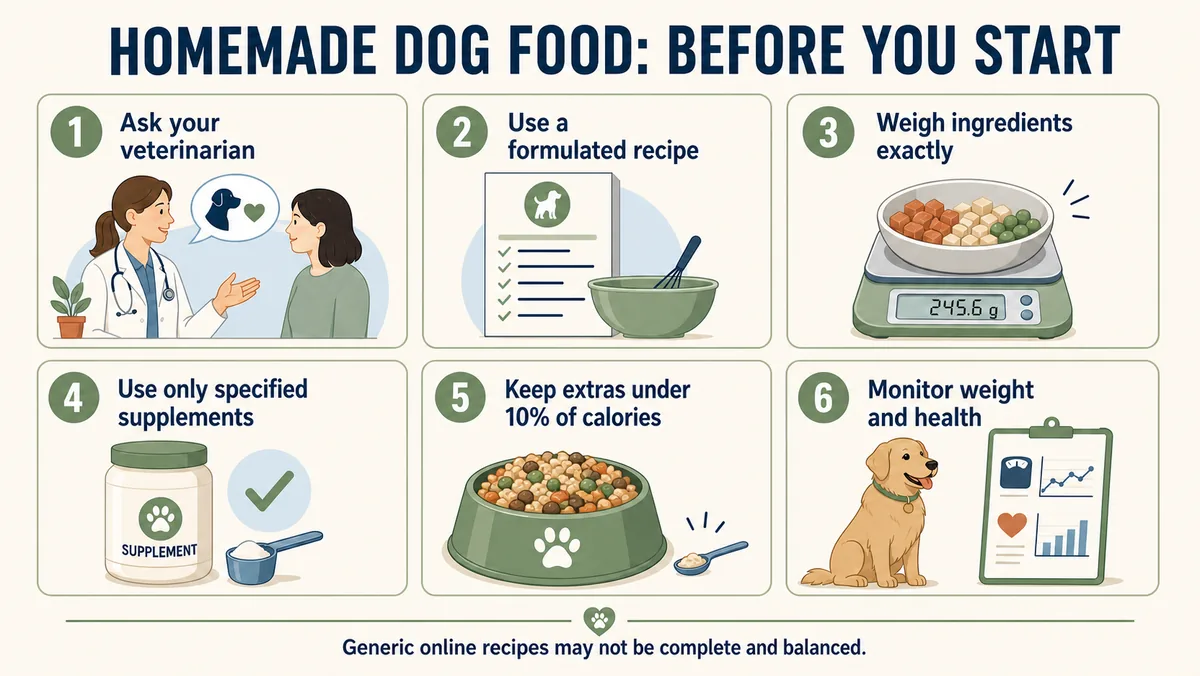
For a diet that will provide most or all of your dog’s daily calories, ask your veterinarian for guidance or a referral to a board-certified veterinary nutrition specialist. The recipe should be designed for your dog’s current needs and include exact ingredient weights, preparation instructions, supplements, and daily calories.
Puppies, pregnant or nursing dogs, seniors, and dogs with medical conditions require particular care. Do not use a general adult maintenance recipe for these dogs.
2. Use a small homemade topper—not a replacement diet
If your goal is simply to make a regular meal more interesting, a small amount of plain, dog-safe food may be a lower-risk option than replacing the complete diet.
UC Davis recommends that at least 90% of a dog’s calories come from a complete and balanced diet. Treats, table foods, and other extras should generally remain within the remaining 10%. Because even a small portion can be inappropriate for a dog with pancreatitis, allergies, kidney disease, obesity, or another condition, confirm suitable ingredients with your veterinarian.
Remember that 10% refers to calories, not the visual volume of the bowl.
3. Follow a temporary veterinary feeding plan
Veterinarians sometimes recommend a short-term home-prepared diet during illness or while identifying tolerated ingredients. These temporary diets are not necessarily complete enough for long-term feeding. Ask how long to use the plan, how much to feed, and when your dog should return for reassessment.
Why Universal Ratios and Supplement Rules Are Unreliable
Online recipes often use simple formulas such as a fixed percentage of meat, grains, and vegetables. They may also recommend one amount of eggshell, multivitamin, or fish oil for every batch.
These shortcuts cannot account for the nutrient content and calorie density of every ingredient. They also cannot account for differences between dogs.
A general dog multivitamin does not automatically balance a homemade recipe. It may lack a nutrient the recipe needs, provide an inappropriate amount, or duplicate nutrients already supplied by other ingredients. Calcium is essential, but the correct source and quantity must be calculated alongside phosphorus and the rest of the recipe.
Use only the supplements, exact products, and amounts specified by the professional who formulated the diet. More is not better, and substitutions should be approved before use.
How Much Homemade Food Should You Feed?
There is no reliable universal rule based only on a percentage of body weight. Dogs of the same weight may have very different calorie needs, and two homemade recipes can contain very different calories per gram.
A veterinary professional can estimate a starting calorie target using your dog’s history and body condition, then adjust it according to weight trends. Measure food accurately—ideally with a digital kitchen scale—and monitor your dog’s weight and body condition regularly.
Contact your veterinarian if your dog is gaining or losing weight unexpectedly.
Helpful Tool: A Digital Kitchen Scale
If a veterinary nutrition specialist gives you a recipe in grams, a digital kitchen scale helps you follow those amounts consistently. Volume measures such as cups and spoons can vary, while weighing ingredients makes it easier to reproduce the formulated recipe and divide a prepared batch into accurate portions.
A scale does not make a generic recipe complete or balanced, and it cannot replace professional formulation. It is simply a practical tool for following an already formulated recipe accurately. The Etekcity Digital Kitchen Scale measures in grams and includes a tare function, making it easier to weigh ingredients in a separate bowl.
Affiliate note: If you purchase through this Amazon link, we may earn a commission at no additional cost to you.
Food Safety Still Matters
Home cooking also requires careful handling and storage.
- Cook animal proteins and eggs thoroughly unless your veterinarian has given different instructions.
- Wash hands, utensils, counters, bowls, and food containers after preparation.
- Refrigerate prepared food promptly in sealed containers.
- Freeze portions that will not be used within the timeframe provided by your veterinarian.
- Thaw food safely in the refrigerator.
- Discard food that has been left out too long or shows signs of spoilage.
- Never add onion, garlic, chives, grapes, raisins, chocolate, xylitol, macadamia nuts, alcohol, or other ingredients known to be dangerous to dogs.
- Do not feed cooked bones; they can splinter and cause injury or obstruction.
If your dog may have eaten a toxic food or swallowed a bone or other object, contact a veterinarian or animal poison-control service promptly.
Before You Change Your Dog’s Diet
Discuss the change with your veterinarian, especially if your dog has ongoing itching, vomiting, diarrhea, weight changes, urinary problems, or another health concern. These signs have many possible causes, and changing ingredients without a diagnosis can delay appropriate care.
Ask these questions:
- Is home cooking appropriate for my dog’s health and life stage?
- Should the homemade food be a complete diet, a temporary plan, or a small topper?
- Who will formulate and review the recipe?
- What exact ingredients and supplements must I use?
- How should I measure portions and monitor body condition?
- When should the diet and my dog’s health be reassessed?
Introduce a new diet according to the schedule recommended for your dog. Some dogs need a gradual transition, while a veterinarian may recommend a different approach in particular medical situations.
When to Stop and Call Your Veterinarian
Contact your veterinarian if your dog develops repeated vomiting, diarrhea, marked lethargy, abdominal pain, refusal to eat or drink, facial swelling, hives, difficulty breathing, or another concerning change after a diet transition.
Also arrange a review if the recipe becomes difficult to follow, an ingredient or supplement is unavailable, or family members have begun making substitutions. This “recipe drift” can gradually turn a well-formulated diet into an unbalanced one.
Frequently Asked Questions
Can a dog multivitamin make any homemade recipe complete?
No. A supplement must be matched to the nutrient profile of the exact recipe and the dog’s needs. A general multivitamin should not be treated as nutritional insurance for an unformulated diet.
Is chicken and rice a complete homemade dog food?
No. Chicken and rice may sometimes be used in a short-term veterinary feeding plan, but it is not a complete and balanced long-term diet by itself.
Can homemade food help a dog with itchy skin?
Itching can be caused by parasites, environmental allergies, infections, food reactions, and other conditions. A homemade diet is not a reliable diagnostic test unless it is part of a controlled elimination trial designed and monitored by a veterinarian.
Is homemade dog food safe for puppies?
Growing puppies have demanding nutrient and mineral requirements. An improperly balanced diet can affect development, so a puppy’s home-prepared diet should be formulated specifically for growth by a qualified veterinary nutrition professional.
Can I replace part of the kibble with homemade food?
Small extras may be acceptable for many healthy adult dogs, but they add calories and can dilute the balanced diet. Keep extras limited and ask your veterinarian what is appropriate for your dog.
The Bottom Line
Homemade dog food can offer control over ingredients and may be useful for individual preferences or medical needs. The safe version is not a universal online recipe—it is a precisely formulated plan that meets the needs of a particular dog and is followed without casual substitutions.
If you want to cook every meal, begin with your veterinarian and a veterinary nutrition specialist. If you only want to add a little fresh food, keep it small, plain, and compatible with your dog’s health. Either way, careful planning is more important than an attractive bowl.
This article is for general education and does not replace veterinary diagnosis or individualized nutrition advice.