
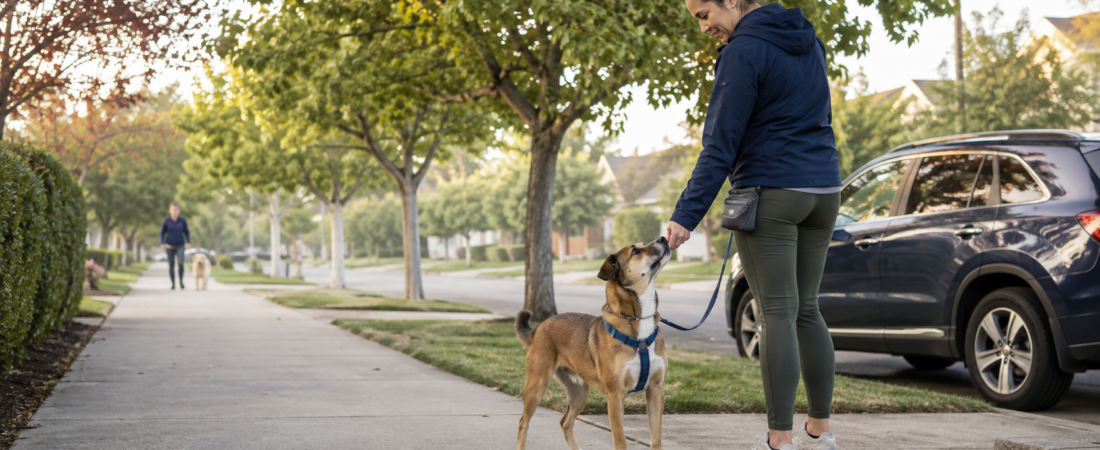
When your dog barks, lunges, freezes, or pulls toward a trigger, an ordinary walk can feel like a high-stakes obstacle course. You may start scanning every corner, changing direction without warning, or worrying about what other people think. That does not mean you have failed, and it does not make your dog “bad.” It means your dog is having a response that deserves safety, curiosity, and a practical plan.
There is no instant cure for a reactive dog on walks. Progress may be uneven, and some dogs will always need thoughtful management. The encouraging part is that you can often make walks safer and less stressful by reducing pressure, noticing early signals, and reinforcing behaviors you want to see.
Quick answer
If your dog reacts on walks, create distance first. Choose quiet, open routes; track triggers; and practice an emergency U-turn and a simple “find it” food-search game away from triggers. When your dog notices a trigger but can still eat, move, and respond, reward that calm observation. Do not punish, jerk the leash, force greetings, or deliberately overwhelm your dog. Sudden behavior change, possible pain, bite risk, severe fear, or aggressive behavior calls for a veterinarian and an appropriately credentialed, reward-based behavior professional.
Reactivity is not the same as aggression
Reactivity is a strong response to something in the environment. On a walk, the trigger might be another dog, a stranger, a bicycle, traffic, wildlife, or a particular sound. A reactive dog may bark, lunge, stare, freeze, hide, spin, whine, or pull. The emotion underneath may be fear, frustration, excitement, overwhelm, pain, or a mixture of these. Dogs Trust specifically notes that dogs described as reactive are not necessarily aggressive.[2]
Aggression refers to behaviors that threaten or may cause harm, such as snapping or biting. A reactive dog can show aggressive behavior, but the labels are not interchangeable. You cannot reliably identify motivation from one dramatic moment alone. Safety matters more than guessing, and a qualified professional can assess the whole pattern.
Why a dog may react on walks
Common emotional contributors include fear, anxiety, frustration at being restrained by a leash, high excitement, sensory overload, and learned expectations from earlier experiences. A dog who wants another dog to move away may discover that barking works when the other dog leaves. A social dog who expects to greet everyone may become frustrated when the leash prevents access. Either dog can look loud and intense while needing a different individualized plan.
Health can also affect behavior. Pain, reduced mobility, sensory changes, neurological disease, hormonal disease, and other medical problems may increase irritability or change how a dog responds. VCA advises using history, physical examination, and—when indicated—diagnostic testing to investigate medical and behavioral contributors rather than assuming there is only one cause.[4]
Subtle signals are easy to miss. In Dogs Trust’s voluntary 2024 UK survey, 80% of owners reported confidence in reading canine body language, but only 24% consistently identified worried behaviors in the survey task.[5] That is a useful reminder to observe carefully, not a reason to blame yourself.
Early warning signs and “threshold”
Watch for a closed mouth, slowed movement, sudden scanning, head turns, lip licking, yawning, ears held back, a lowered body, a tucked tail, weight shifting away, panting unrelated to heat, stiffening, freezing, hard staring, or refusal of food. Your dog’s first signs may be much quieter than barking or lunging.
“Threshold” is a practical way to describe the point where a trigger becomes too intense for the dog to cope and learn comfortably. Distance is one factor, but movement, duration, noise, available escape routes, accumulated stress, and how the dog feels that day also matter. Under threshold, your dog can usually notice the trigger while still eating, sniffing, moving with you, or responding to an easy cue. Near or over threshold, the body may become rigid, food may be ignored, and attention may lock onto the trigger. VCA recommends keeping behavior work under threshold and proceeding slowly.[3]
If your dog cannot take food, do not assume stubbornness. Increase distance, use a visual barrier, or leave. The goal is not to test how much your dog can endure; it is to prevent escalation and create conditions where learning is possible.
7 calm, force-free first steps
1. Create distance early
Distance is your first safety tool. Cross the road when safe, turn down a side street, step behind a parked car, or make a wide arc. Act when you notice the early signals—not after an outburst has begun. Keep a secure hold on the leash without dragging your dog toward or past the trigger. If an off-leash dog approaches, prioritize leaving and ask the other handler to call their dog.
Moving away is not “rewarding bad behavior.” It lowers immediate pressure and helps prevent rehearsal of a reaction. Dogs Trust and VCA both recommend route changes and enough space to protect physical and emotional safety.[2][3]
2. Plan low-trigger routes and times
Choose quiet times, wide paths, good sightlines, and several exits. Avoid narrow trails or busy entrances where surprise encounters are hard to escape. A shorter, calmer walk can be more useful than a long walk filled with repeated reactions. On difficult days, replace part of the outing with rest, sniffing, play, or dog enrichment ideas at home.
3. Keep a simple trigger diary
After each walk, record the trigger, approximate distance, location, time, early body-language signs, reaction intensity, whether your dog could eat, and how quickly recovery happened. Include sleep, unusual activity, medication changes, appetite, limping, or other health observations. Patterns can help you plan safer walks and give a veterinarian or behavior professional more useful information.
4. Teach an emergency U-turn at home first
In a quiet room, say a cheerful cue such as “this way,” turn 180 degrees, and reward your dog for following. Practice a few easy repetitions, then try the garden, hallway, or another low-distraction place. Gradually add mild distractions only while your dog remains relaxed.
On a walk, use the cue before your dog fixates. Turn smoothly and move away rather than yanking the leash. A practiced U-turn gives both of you a familiar exit plan when a trigger appears unexpectedly.
5. Use a simple “find it” cue
At home, say “find it,” then drop one treat where your dog can easily see it. Repeat until the words predict a short food search. Next, scatter a few treats over a clean, safe patch of ground. Sniffing can direct attention away from a distant trigger and help you move toward an exit, but use it only when your dog can still eat and the environment is safe.
Do not scatter food near traffic, unknown dogs, hazards, or anything your dog guards. If your dog will not search, calmly increase distance instead of repeating the cue.
6. Reward calm observation under threshold
Start far enough away that your dog can notice the trigger without escalating. The moment your dog looks calmly, mark it with a brief word such as “yes” and offer a high-value treat. You can also reward voluntary check-ins, turning away, sniffing, or moving with you. Keep sessions brief and end while your dog is successful.
This is not about luring your dog closer. It is a carefully managed pairing of the trigger with something positive while the dog feels safe. AVSAB recommends reward-based methods for training and behavior modification and advises against aversive methods.[1] For significant fear or aggression, have a qualified professional design and supervise the plan.
7. Arrange professional help when needed
Professional guidance is not a last resort. Start with your veterinarian when behavior changes suddenly, pain or illness may be involved, or reactions are severe. For behavior support, look for an appropriately credentialed professional who uses transparent, reward-based methods and collaborates with your veterinarian. Ask exactly what equipment and techniques they use. Avoid anyone who relies on pain, fear, intimidation, “dominance,” or guaranteed results.
What not to do
- Do not punish the reaction. Shouting, startling, or causing pain can add fear or frustration to the sight of the trigger.
- Do not use leash corrections. Jerking the leash does not address the underlying emotion and can increase discomfort.
- Do not force greetings. Your dog does not need to meet every dog or person, and an on-leash greeting can remove the option to move away.
- Do not flood your dog. Prolonged or intense exposure that overwhelms the dog is not the same as gradual, under-threshold behavior work.
AVSAB’s humane training statement rejects aversive tools and techniques, including leash jerks and flooding, and recommends teaching desired responses with reward-based methods.[1] VCA likewise cautions that punishment may increase arousal, frustration, fear, and the risk of redirected aggression.[3]
When to contact a veterinarian or behavior professional
Contact your veterinarian if the behavior began suddenly, is rapidly worsening, follows an injury or illness, or appears alongside limping, sensitivity to touch, appetite or sleep changes, altered movement, sensory decline, or other health concerns. Medical and behavioral factors can occur together, and treating pain or illness may be an essential part of the plan.[4]
Seek prompt, individualized behavior help if your dog has bitten or attempted to bite, redirects toward the handler, cannot safely pass people or animals, shows severe fear or aggressive behavior, escapes equipment, or creates a risk to anyone. Until assessed, avoid known high-risk situations. A veterinarian can help rule out medical contributors and refer you to an appropriately credentialed behavior professional; a veterinary behaviorist may be especially appropriate for complex or severe cases.
A realistic takeaway
Success does not have to mean your dog greets everyone or walks through a crowded park. It may mean noticing a trigger sooner, turning away smoothly, recovering faster, or choosing a quiet route without guilt. Management is not failure; it is part of humane care. Build skills in easy places, protect distance, reward what you want repeated, and get qualified help when safety or welfare requires it.
Sources
- American Veterinary Society of Animal Behavior: Position Statements and Humane Dog Training
- Dogs Trust: Reactive Dogs—Why It Happens and How to Help
- VCA Animal Hospitals: Aggression Toward Unfamiliar Dogs—Treatment
- VCA Animal Hospitals: Is a Behavior Problem Medical or Behavioral?
- Dogs Trust: National Dog Survey 2024
This article is for general educational purposes only. It does not diagnose your dog, replace veterinary care, or provide an individualized behavior plan. Consult your veterinarian and an appropriately credentialed behavior professional for advice tailored to your dog, especially when there is pain, sudden behavior change, severe fear, aggression, or bite risk.