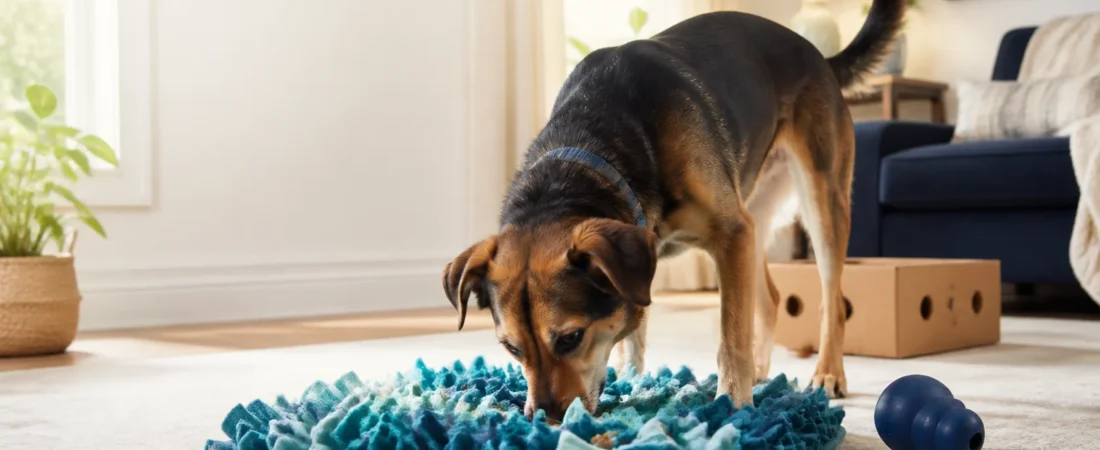
Watch the short TailSprig guide, then use the detailed steps below.
If your dog follows you from room to room, steals socks, barks at every sound or somehow finds a second wind after a long walk, the problem may not be a lack of exercise. Many dogs also need a job for their nose and brain.
Dog enrichment does not mean buying a cupboard full of complicated toys. It means giving your dog safe chances to sniff, search, chew, solve, choose and learn. A cardboard box, a towel and part of your dog’s normal meal can be enough to turn ten quiet minutes into a satisfying little challenge.
This guide includes simple dog enrichment ideas for rainy days, busy workdays and ordinary evenings. Start easy, supervise the first few attempts and stop while your dog is still having fun.
Quick answer: The easiest enrichment routine is to replace one food-bowl meal with a supervised sniffing or puzzle activity, add a five-minute training game, and rotate toys instead of leaving everything available all day.
Some links below are affiliate links. TailSprig Living may earn a commission from qualifying purchases, including as an Amazon Associate, at no extra cost to you.
Popular picks
Two useful enrichment tools
Choose by how your dog likes to work: licking and chewing, or sliding and searching.
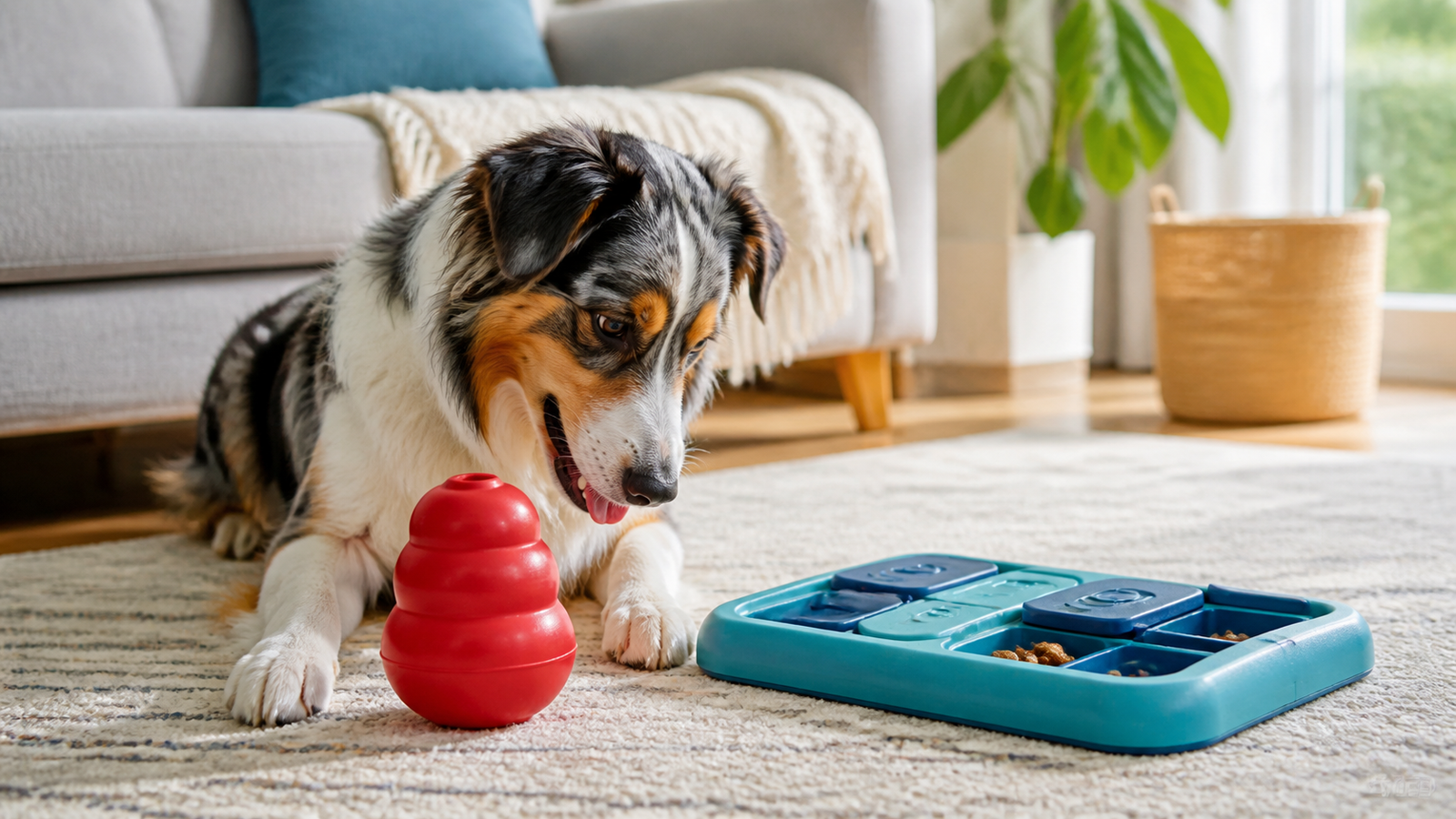
Best for stuffing and freezing
KONG Classic Dog Toy
Check current details on Amazon
A durable, fillable rubber toy for measured meals, wet food and supervised chewing.
Check first: Select the correct size and inspect for damage after use.
Best for problem-solving
Outward Hound Nina Ottosson Dog Brick
Check current details on Amazon
A Level 2 treat puzzle for dogs ready to slide, lift and search.
Check first: Start with uncovered compartments and supervise loose parts.
Amazon prices and availability can change. Check the current size, materials, seller and return terms before ordering.
What counts as enrichment for a dog?
Enrichment is an activity or environment that lets a dog use natural behaviors in an appropriate way. That can include sniffing, foraging, chewing, digging, chasing, learning or simply choosing where to rest. It should fit the individual dog. A bold young terrier may love a noisy cardboard search box; a cautious senior may prefer treats scattered in a folded towel.
The goal is engagement, not frustration. A good activity keeps your dog interested and leaves them relaxed or pleasantly tired. If they paw frantically, bark at the toy, walk away or begin tearing and swallowing unsafe pieces, make the task easier or end the session.
1. Scatter part of a meal for a sniff search
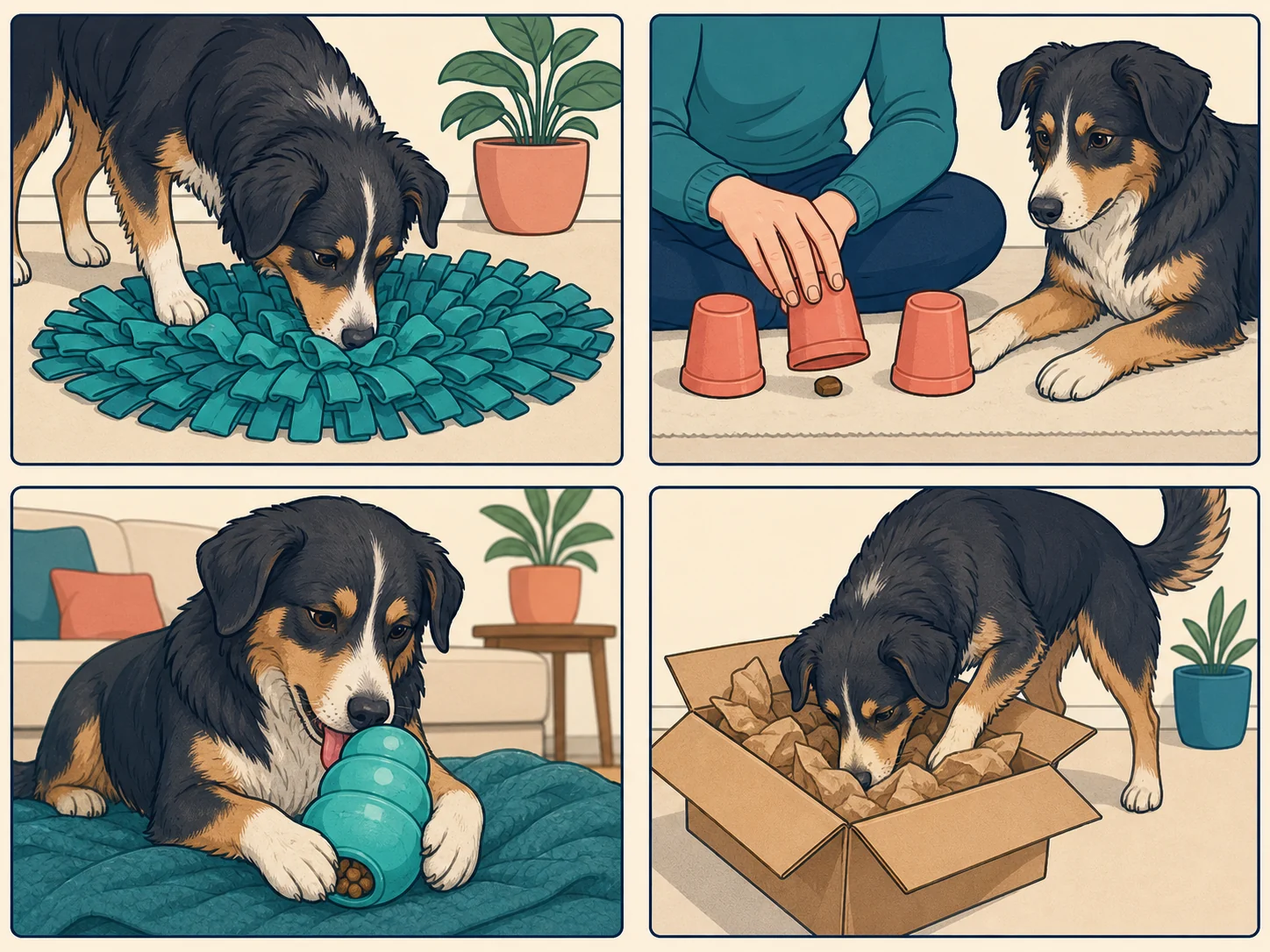
Use a clean room, dry lawn or snuffle mat. Ask your dog to wait, scatter a measured portion of kibble, then release them with a cue such as “find it.” Begin with pieces in plain sight. Once your dog understands the game, spread the food farther apart or place a few pieces beside furniture legs.
This is more useful than tossing extra treats on top of a full daily ration. Measure the food first so the game remains part of a balanced day rather than an accidental second dinner.
2. Make a rolled-towel puzzle
Lay a bath towel flat, sprinkle a small amount of kibble across it and roll it loosely from one end. Let your dog unroll it with their nose. For beginners, keep the roll soft and leave food visible near the edge. For experienced dogs, fold the towel in a loose zigzag.
Supervise closely. This game is not suitable for a dog who shreds or swallows fabric. Remove the towel as soon as the food is gone.
3. Build a cardboard search box
Place crumpled plain packing paper, a few empty paper tubes and several treats in a sturdy open box. Let your dog investigate. Keep the lid off for the first session. Later, nest one small open box inside a larger one.
Avoid staples, tape, plastic film, glossy packaging and small pieces your dog could swallow. If your dog eats cardboard rather than moving it aside, choose a reusable puzzle instead.
4. Stuff and freeze a rubber food toy
A fillable rubber toy can stretch a portion of wet food or soaked kibble into a longer activity. Pack it loosely the first time so food falls out easily. As your dog learns, press the mixture more firmly and chill or freeze it.
Choose a size designed for your dog and check the toy for splits after every use. Freezing makes food last longer, but it can also make the challenge harder—do not start with a solid frozen block for a dog who has never used the toy.
5. Play the three-cup game
Place three lightweight cups upside down. Hide one treat under a cup while your dog watches, then invite them to choose. Reward the correct cup by lifting it. At first, do not shuffle. Once the rule is obvious, move two cups slowly before giving the cue.
This is a short thinking game, not a test. Two or three successful rounds are enough.
6. Teach a useful “touch” cue
Hold an open palm a few inches from your dog’s nose. When they investigate and touch it, mark the moment with “yes” and give a treat. Repeat until your dog deliberately bumps your hand. Then add the word “touch.”
This cue becomes useful for recall practice, vet handling, moving around the house and confidence-building. Keep sessions under five minutes and finish with an easy success.
7. Create a toy rotation
Leaving fifteen toys on the floor can make all of them feel ordinary. Keep most toys in a closed box and offer three or four at a time: perhaps one chew, one tug, one food toy and one soft toy. Swap the set every few days.
Rotation adds novelty without constant shopping. It also makes it easier to inspect toys for loose seams, damaged rubber and missing parts.
8. Set up a supervised shredding project
Some dogs love pulling apart paper. Put a few treats inside loosely folded plain paper, then place the parcels in an open cardboard box. Stay nearby and remove pieces as the dog opens them.
Skip this activity if your dog eats paper, guards found objects or becomes overexcited. Shredding is enrichment only when it is controlled and safe.
9. Try a muffin-tin food puzzle
Drop kibble into several cups of a clean muffin tin and cover some cups with dog-safe balls large enough not to swallow. Your dog must move the balls to reach the food. Leave several cups uncovered for the first attempt.
Metal tins can slide and make noise, so place the tray on a non-slip mat. A cautious dog may prefer a silicone version.
10. Play hide-and-seek with a person
Ask your dog to stay with one person while another hides behind a door or around a corner. Call once, then celebrate when the dog finds the hiding person. Make the first hiding places obvious.
The reward can be a treat, praise or a short tug game. This combines scent, recall and social connection.
11. Turn a walk into a sniff walk
Not every walk needs to be about distance. On a safe route, loosen the schedule and let your dog investigate selected patches of grass, tree trunks and scent trails. A ten-minute sniff-focused walk may be more mentally satisfying than marching the same block at speed.
Avoid unknown food, animal waste, treated lawns and areas where your dog cannot move away comfortably from other dogs.
12. Make a simple indoor obstacle course
Use stable household items to create a low, slow course: walk around a chair, step over a broom handle placed on the floor, pause on a mat and weave between two boxes. Lure or cue your dog through the route without forcing them.
Keep everything low and non-slip. Puppies, seniors and dogs with joint or back concerns should avoid jumping. Ask your veterinarian or a qualified professional if you are unsure what movement is appropriate.
13. Practice “find the toy”
Begin with one favorite toy. Let your dog see you place it a few feet away, then say “find your toy.” Reward any move toward it. Gradually hide it behind an easy obstacle, then in another part of the room.
Using the same toy and cue helps your dog understand the task. Later, you can teach names for two different objects.
14. Offer a safe digging outlet
Dogs who love to dig can use a supervised digging box filled with clean play sand or shredded paper. Bury a durable toy just below the surface and encourage searching there.
Place the box where spilled material is manageable. Do not use cocoa mulch, treated soil or anything dusty enough to irritate eyes and airways.
15. Let your dog make small choices
Choice is often overlooked. Offer two toys and let your dog select one. On a safe walk, allow a choice between two directions. Present two resting spots with different textures. Small decisions make a routine more interesting and show you what your dog actually prefers.
A realistic 7-day enrichment plan
You do not need all fifteen ideas at once. A simple week could look like this:
- Monday: scatter breakfast and practice “touch” for three minutes.
- Tuesday: rolled-towel puzzle with part of dinner.
- Wednesday: sniff walk and a rotated chew toy.
- Thursday: cardboard search box under supervision.
- Friday: three-cup game and hide-and-seek.
- Saturday: simple obstacle course or a new walking route.
- Sunday: stuffed food toy while you reset the toy rotation.
Watch the dog rather than the clock. A short activity that ends well is better than a long one that turns into frustration.
Optional guided program
Want a more structured brain-game plan?
If your dog enjoys the scent searches and puzzle games above, Brain Training for Dogs is a paid digital course created by CPDT-KA certified dog trainer Adrienne Farricelli. It organizes 21 games and step-by-step training activities for owners who prefer a guided program.
Affiliate disclosure: TailSprig Living may earn a commission if you purchase through this link, at no extra cost to you. This is an optional resource; individual results vary, and it does not replace veterinary care or help from a qualified behavior professional.
Useful products to consider
You can do most of this guide with household items, but a few reusable tools make enrichment easier. We suggest comparing size, material, cleaning instructions and your dog’s play style before buying.
- KONG Classic or another size-appropriate fillable rubber toy for soaked kibble and wet food.
- Outward Hound Nina Ottosson beginner puzzle for dogs new to sliding and lifting tasks.
- A washable snuffle mat with a non-slip base for measured meals and scent work.
- West Paw Toppl as another refillable food-puzzle shape.
- A treat pouch and clicker for short training sessions.
These are product ideas, not claims that every item suits every dog. Heavy chewers require close supervision, and no puzzle is a substitute for safe social time, exercise or veterinary care.
Common enrichment mistakes
The most common mistake is starting too hard. If all the food is sealed inside a frozen toy, a beginner may give up. Make the first round almost comically easy, then add difficulty one change at a time.
Another mistake is using enrichment only to exhaust a dog. Constant high-arousal games can create a dog who expects more excitement, not more calm. Mix active play with sniffing, chewing, quiet food puzzles and rest.
Finally, do not assume every DIY idea online is safe. Strings, socks, plastic bottles, tape, sharp cardboard edges and small balls can become hazards. Supervision and individual judgment matter more than novelty.
When enrichment is not enough
Sudden restlessness, destructive behavior, changes in sleep, unusual vocalizing or reluctance to play can be signs of pain, fear or illness. Enrichment can improve daily life, but it should not be used to cover up a medical or serious behavior problem. Contact your veterinarian when behavior changes suddenly or worries you.
The takeaway
The best dog enrichment ideas are the ones you can repeat safely and your dog genuinely chooses to do. Begin with one meal-based sniffing game and one short training game this week. Notice what makes your dog curious, what feels too difficult and what helps them settle afterward. That observation is more valuable than the fanciest toy.
Sources and further reading
- American Kennel Club, “Fun, Cognitive Training Games to Make Your Dog Smarter.”
- American Kennel Club, “Brain Games for Dogs: When Can a Puzzle Be the Solution?”
- American Kennel Club, “How to Enrich Your Dog’s Life and Strengthen Your Bond.”
Pet-care information on TailSprig Living is educational and does not replace advice from your veterinarian or a qualified behavior professional.
📋 Free printable: At-Home Dog Grooming Checklist
Keep track of your dog’s coat care between grooms. Print it and stick it on the fridge — no sign-up needed.