
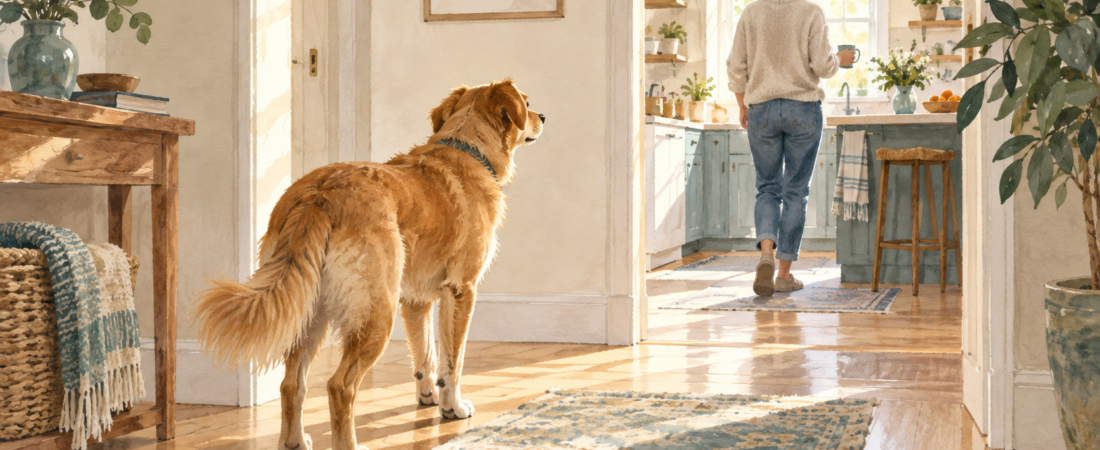
You stand up to make coffee, and your dog gets up too. You walk to the bathroom, and a familiar nose appears at the door. Even a two-minute trip to another room comes with a four-legged escort. Living with a “shadow dog” can feel sweet, funny, inconvenient, or worrying, sometimes all at once.
In many cases, following is ordinary social behavior that has become part of a dog’s daily routine. The important questions are not simply whether your dog follows you, but how relaxed they look, whether they can settle apart from you, what happens when you leave home, and whether the behavior changed suddenly.
Quick answer
Your dog may follow you because they enjoy your company, expect food or activity, have learned that staying close earns attention, feel uncertain, or simply prefer resting where you are. Following by itself does not prove separation anxiety. Concern rises when your dog cannot settle without you, panics around departures, damages exits, vocalizes persistently, soils the house only when alone, attempts to escape, or shows a sudden personality change. In those cases, start with your veterinarian and, when needed, a qualified behavior professional.
Why does my dog follow me everywhere?
1. Your dog values social closeness
Dogs are social animals, and many choose to stay near people they trust. Your movement also carries useful information: where the household is gathering, whether something interesting is about to happen, and where a comfortable resting place might be. A relaxed dog who follows you, lies down, and naps is usually showing a preference, not an emergency.
2. Following has been rewarded
Behavior that pays tends to repeat. If following you leads to eye contact, conversation, petting, a treat, a walk, or access to the sofa, your dog has good reasons to keep doing it. You do not need to have deliberately trained this pattern. Small rewards delivered many times a day can make shadowing very reliable.
This does not mean affection is a mistake. It means you can also reward independence. Notice when your dog chooses a bed, mat, or sunny spot away from you and calmly place a treat there. That makes settling independently worthwhile without turning closeness into a conflict.
3. Your routine predicts something your dog wants
Dogs are excellent observers of patterns. Walking toward the kitchen may predict breakfast. Picking up certain shoes may predict a walk. Going to your desk may mean a long nap nearby. Your dog may be following the chain of events rather than asking for constant reassurance.
Check basic needs before labeling the behavior “clingy.” Does your dog need a toilet break, water, age-appropriate exercise, rest, play, or a meal? If the essentials are covered, provide a predictable rhythm that includes interaction and quiet time. Predictability can help a dog understand when activity is likely and when it is time to settle.
4. Your dog is bored or looking for a job
A dog with little to do may make your movements the day’s main event. Following can become the easiest available activity, especially when walks, sniffing, play, training, and opportunities to chew or forage are limited.
Try short sniff walks, scatter feeding, reward-based training, safe chew options, or food puzzles. Our practical dog enrichment ideas at home can help you build variety without turning every hour into entertainment.
5. Something has made your dog feel uncertain
Changes can increase proximity-seeking. A move, new household member, unfamiliar visitor, construction noise, storm, altered work schedule, or loss of a familiar person or animal may lead a dog to stay closer to their trusted human. AAHA notes that routine changes, traumatic experiences, limited socialization, and individual predisposition can contribute to anxiety around separation.[1]
Look at the whole body. A dog seeking ordinary company can usually soften, sniff, eat, play, and sleep. A worried dog may pace, pant when it is not hot, tremble, scan the room, startle, hide, whine, or struggle to settle. Reduce pressure, restore a steady routine where possible, and avoid punishing fear.
6. Your dog may be showing separation-related distress
Following can appear alongside separation anxiety, but it is not enough to make that diagnosis. The more useful evidence is what happens before and during an absence. The ASPCA lists signs such as persistent barking or howling, elimination, destruction around doors or windows, escape attempts, and repetitive pacing when the guardian is absent.[2] Some dogs become distressed as soon as shoes, keys, or other departure cues appear.
A securely placed camera can show what happens during a brief, ordinary absence. Review for pacing, panting, vocalizing, door-focused behavior, inability to eat, or frantic escape attempts. Do not stage a long absence to “test” your dog. Do not leave a distressed dog alone to obtain footage. If ordinary departures already cause panic, discuss observation and management with your veterinarian first. Video can help your veterinarian or behavior professional distinguish anxiety from boredom, outside noises, incomplete house training, or confinement distress.
7. A health or age-related change may be involved
Pain, reduced vision or hearing, illness, and neurological changes can alter how secure a dog feels. A dog who suddenly follows more closely may be seeking help or reassurance. Senior dogs deserve particular attention. Cornell lists suddenly becoming clingy or avoidant among the possible interaction changes seen with canine cognitive dysfunction, alongside disorientation, sleep changes, house-soiling, pacing, anxiety, and changes in learned behavior.[3]
These signs are not specific to cognitive dysfunction, and aging itself is not a diagnosis. A veterinarian may recommend a physical examination and tests to rule out pain, sensory loss, systemic illness, seizures, or other conditions. Early evaluation gives you the best chance to address a treatable cause.
What normal following usually looks like
Your dog’s body looks loose and comfortable.
They can remain on a bed or in another room for at least short periods.
They continue eating, playing, sniffing, and sleeping normally.
They do not panic when a door closes or when you prepare to leave.
The pattern is familiar rather than sudden or rapidly worsening.
A dog can be very people-oriented and still cope with ordinary separation. The goal is not indifference; it is comfort both near you and during realistic periods of independence.
How to encourage comfortable independence
Begin while you are home and your dog is calm. Set up a comfortable mat a few feet away. Reward your dog for stepping onto it, lying down, and remaining relaxed while you make a small movement. Build duration and distance gradually. If your dog gets up, make the next repetition easier rather than scolding or repeatedly sending them away.
Pair quiet time with something appropriate your dog enjoys, such as a safe chew or part of a meal in a food toy. Practice very brief out-of-sight moments that end before concern appears. AAHA recommends starting with an absence short enough for the pet to remain calm and increasing time gradually.[1] A crate is not a universal solution; confinement can intensify distress in some dogs.
Keep departures and returns calm, and never punish damage, vocalizing, or house-soiling discovered afterward. The ASPCA emphasizes that anxious behaviors are distress responses, not spite or disobedience, and punishment can worsen the problem.[2] Moderate or severe separation anxiety usually needs a carefully paced plan rather than do-it-yourself trial and error.
When to seek professional attention
Arrange a veterinary appointment if the following is new, escalating, or paired with changes in appetite, thirst, sleep, mobility, elimination, awareness, vision, hearing, or response to touch. Seek prompt help for self-injury, frantic escape attempts, prolonged distress, refusal to eat when alone, or severe disruption to daily life. Contact a veterinarian urgently if your dog may be injured or ill.
For significant anxiety, ask your veterinarian about referral to a board-certified veterinary behaviorist or another appropriately qualified, reward-based professional with separation-case experience. Medication may be part of a veterinarian-led treatment plan for some dogs; it should not be improvised. A professional can use your history and video to create steps that stay below your dog’s panic threshold.
What to do next
Most shadowing is not a problem that must be eliminated. Watch the emotional picture: relaxed companionship is different from a dog who cannot cope. Meet daily needs, reward calm settling away from you, practice independence in tiny successful steps, and pay attention to sudden change. If following comes with distress or health changes, getting help is not an overreaction, it is a kind, practical next step.
Sources
American Animal Hospital Association: Separation Anxiety in Pets, Signs, Causes, and Solutions (updated July 14, 2026).
Cornell University College of Veterinary Medicine: Cognitive Dysfunction Syndrome (updated October 21, 2025).
This article is for general educational purposes only. It does not diagnose your dog or replace veterinary care or an individualized behavior plan. Consult your veterinarian about sudden behavior change, possible pain or illness, severe anxiety, self-injury, or any concern about your dog’s welfare.