
Your dog lies down, but their eyes stay fixed on the treat pouch. The moment you move a hand, they spring up. They may understand a position without feeling ready to rest.
Mat practice works best when you separate those two goals: finding the resting place and becoming comfortable there. You can begin at home with a familiar blanket and an ordinary quiet moment.
What a settle should look like
The aim is physical and emotional relaxation, not simply keeping paws inside a rectangle. VCA recommends watching body language and considering excitement, fear, frustration or discomfort when a dog struggles to settle. Meet ordinary needs for activity and a toilet break before practice. VCA teaching settle and calm.
Following you around is a different question. Our guide to dogs that follow their owners explains what to observe; this article focuses on a practical resting routine while you are present.
Set up a small, manageable session
Choose a quiet part of a familiar room and a comfortable mat with space for your dog to lie naturally. Have suitable small rewards ready before inviting the dog over. Put the phone down and leave household chores until later: for this first attempt, observing your dog is the task.
Use rewards your dog likes, delivered calmly. Reward-based training is the approach recommended by the RSPCA. Do not push a dog into a down or scold them for leaving the mat.
First, make the mat familiar
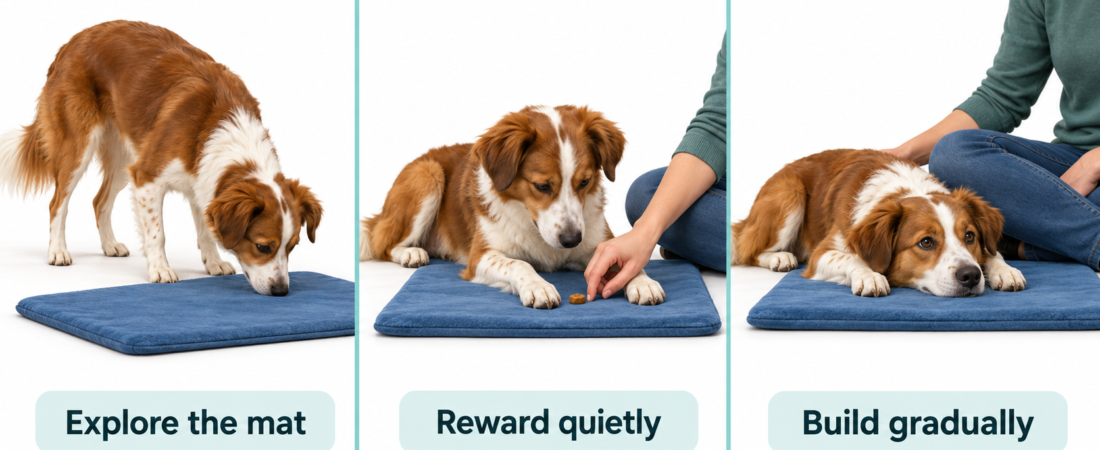
Battersea’s progression starts with rewarding investigation of the mat, then paws on it and eventually lying down. Place rewards on the mat so the location becomes part of the exercise. If your dog already understands a comfortable down, you can use it; otherwise allow an easier starting point instead of repeating a cue they do not know. Battersea settle guide.
Avoid treating this as a checklist to finish in one sitting. Note where your dog is comfortable today. A dog willing to approach the mat has a different starting point from one already choosing to lie there.
Then notice the quieter moments
Sit nearby. Quietly reward settling rather than turning each reward into an excited interaction. Dogs Trust describes gradually noticing more relaxed behavior, including a shift into a comfortable resting position or the head resting down. Begin with the behavior your dog can offer in that environment. Dogs Trust settle training.
If your dog is rigidly watching your hands, avoid interpreting a long down as proof of relaxation. VCA suggests avoiding food that makes the dog overly excited and quietly placing rewards on the mat. Watch the whole dog, rather than using one movement as a pass-or-fail test.
Change one part of the exercise at a time
Build a little more time between rewards before adding a busy setting. Dogs Trust recommends small increases across sessions, then gradually introducing distractions. If the dog cannot settle, reduce the distraction or increase distance from it.
Here is a practice note you can copy:
• Room and mat used:
• What my dog did comfortably:
• What changed just before they got up:
• One easier version to try next time:
For example, “rested beside my chair until I stood up” gives you a useful next step. It does not mean the next session should include a visitor, an open front door and a longer wait at once. Keep the comparison simple enough to understand what changed.
Common sticking points
The treats become the whole activity. Review reward choice and delivery. Quiet placement may suit this exercise better than enthusiastic praise and rapid hand movements. If practice repeatedly increases arousal, stop and get help adapting the approach.
Home goes well, but a café does not. A new setting adds many variables. Battersea recommends introducing different locations gradually. Start with a manageable setting and retain the option to leave; a mat is not a promise that a dog can tolerate every venue.
The dog gets up whenever you move. Reduce the size of the change. Treat the moment as information about the current difficulty rather than disobedience. Keep your notes focused on what happened, not a target duration borrowed from another dog’s progress.
The dog chews the mat. Stop using that item for the session if they tear or swallow it. Choose suitable equipment and supervise. A special purchase is not essential to begin, and no mat is a substitute for training.
When mat practice is not enough
Sudden restlessness or apparent physical discomfort needs veterinary assessment. Persistent fear or distress calls for individual support from a qualified, reward-based behavior professional. This routine should not be presented as treatment for separation anxiety or as a way to make a frightened dog endure a situation.
For ordinary daily activity alongside rest, explore our dog enrichment ideas. Select activities your dog can enjoy comfortably; you do not need to exhaust them to earn a quiet evening.
Finish with a clear note of the easy version that worked. Repeat that manageable setup before expecting the skill to travel into a busier day. This is general educational guidance, not an individual veterinary or behavior treatment plan.
The educational illustration is AI-generated and does not depict product testing.
An optional portable resting spot
As an Amazon Associate I earn from qualifying purchases. The following is an affiliate link; we may earn a commission if you buy through it.
A familiar blanket is enough to begin. If you want a separate portable bed, compare the Chuckit! Travel Pillow Bed below with your dog’s resting footprint and your floor surface. Petmate describes this model as washable and water-resistant, not waterproof. Supervise use and stop if your dog damages or swallows material. We have not personally tested this product; it does not treat anxiety.