
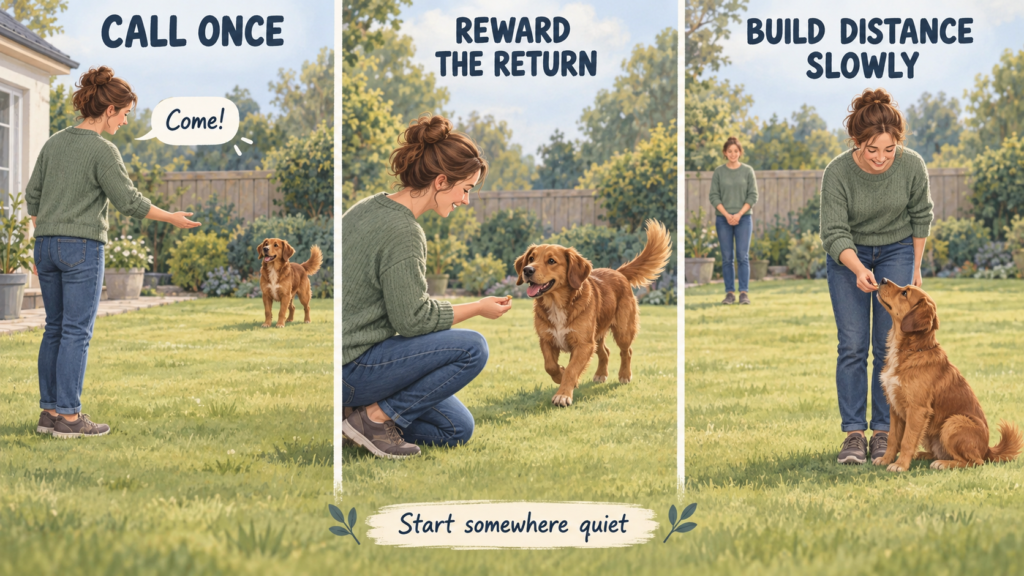
Quick answer: To teach your dog to come when called, begin a few steps apart in a quiet room. Get their attention, say one consistent recall cue, and reward them when they arrive beside you. Build distance and distractions gradually. Outdoors, keep them safely contained or use a fixed-length training line attached to a well-fitted harness.
Your dog comes when called in the kitchen but ignores you in the park. Change the practice setup rather than shout louder. The living room is only the beginning.
Start with a safe, easy setup
Choose a quiet room with secure doors and a clear floor. Have small rewards your dog likes ready before you start. A favorite toy can work for a dog who prefers play. Keep food suitable for your dog’s diet, and include training treats in their daily food allowance.
Before outdoor practice:
- Use a secure enclosed area, or a fixed-length long line on a well-fitted body harness. Attach the line to the harness’s suitable back attachment, following its instructions, rather than to a neck collar.
- Pick a clear space away from roads, livestock, wildlife and loose dogs. A crowded dog park is a difficult starting classroom.
- Inspect the line, clip and harness. Keep the line away from legs and obstacles; gather excess in loose loops without winding it around your hand, wrist or fingers.
- Begin with only the amount of line you can manage. Never jerk it, reel your dog toward you, or let them build speed into a sudden stop. Ask a qualified reward-based trainer for a handling demonstration if needed.
A retractable leash is not the tool used in this guide. Extra length does not make an unsuitable location safe.
Choose one cue and teach attention first
Pick a short word such as “come” or “here” and agree on it with everyone who trains your dog. Their name can ask them to look toward you; the recall word asks them to move back to you. Avoid switching between several phrases.
If your dog does not turn toward their name in the quiet room, practice that first: say it when they are nearby, then reward them for looking at you. Start recall when getting their attention is easy. There is little value in testing a new word while they are absorbed in something else.
Practice the first returns indoors
- Get your dog’s attention while they are a few steps away.
- Say their recall cue once in a friendly voice and take a small step away to invite movement.
- Praise their approach, then give the reward when they arrive beside you. Keep your body welcoming rather than leaning over or lunging at them.
- Let them move away again and try another easy return. Finish after a few comfortable repetitions, before either of you becomes frustrated.
If they do not approach, make the next attempt shorter and easier. You can encourage an initial return with inviting body language or a visible reward; gradually practice without needing to show the reward first. Keep rewarding arrivals.
Help your dog feel comfortable coming close
A dog who stops just beyond your reach has not completed the practical skill you need. They must also feel comfortable being near you when a leash is attached.
Practice handling separately at close range. Slowly reach toward their harness, reward relaxed behavior, and build toward briefly touching the attachment area. If they shrink away, freeze, growl or dodge, stop and make the step easier; do not grab them. Get professional help if handling remains worrying.
When gentle handling is comfortable, occasionally clip on the normal leash, reward, take a few steps, and release them again only within the secure space. Returning need not always mean the enjoyable activity ends.
Take an easier version outdoors
Move to a secure garden or quiet enclosed field. Allow some calm investigation first, then practice from a short distance on the harness and training line. Go back to the easy version, even if indoor practice has gone well.
Manage the line as your dog moves toward and away from you. Keep it clear of their body and your feet. It is a safety backup, not a way to force the response. Do not tether it to yourself or leave your dog attached and unattended.
Try increasing just one challenge:
- A little more distance in the same quiet spot.
- A slightly different position within that area.
- An easy distraction at a distance where your dog can still pay attention.
If the return becomes slower or less consistent, reduce that challenge. Do not add more distance and a busier location together.
What if your dog ignores the cue?
Avoid turning one call into a string of “come, come, come.” If your dog cannot respond, stay calm, keep them safely managed, and go closer or collect them without pulling them in. Then reset in an easier situation.
Reward them when they do return, including a delayed return. Scolding them beside you can make approaching you less appealing next time. Look at what interrupted the response: were they already chasing, was another dog too close, or was the new place simply overwhelming?
A dog who can return from a mild sniff may still be unable to leave a running animal. Keep the line and increase distance from that distraction. If walks involve barking or lunging, use the separate reactive dog walking guide rather than repeatedly testing recall near the trigger.
Make returning part of the fun
During safe practice, call, reward, and let your dog resume exploring on the line. Mix those returns with the necessary ones that finish a walk. Otherwise, the recall word can start predicting the end of every interesting activity.
For an indoor game, two people take turns calling from a short distance and rewarding arrivals, without holding or restraining the dog. Pause if they lose interest. Other dog enrichment ideas can provide variety between sessions.
Choosing a training line
Choose a fixed-length line and clip appropriate for your dog’s size and the space available. Check that you can hold and gather it comfortably, and follow the maker’s care and use instructions. A longer or heavier line is not automatically better. Start with a manageable distance; you do not need to use its full length.
As an Amazon Associate, I earn from qualifying purchases. The product link below is an affiliate link. One example is the PetSafe Training Lead in the 20-foot, black variant. Choose a length and clip suitable for your dog and practice space; this example is not a fit recommendation for every dog. The line does not teach recall by itself.

Check your dog’s harness fit before adding the line. Replace damaged equipment, and pause if the line becomes tangled or your dog bites it. No line is a guarantee against injury or escape.
Does recall practice mean my dog can go off leash?
No. This is a beginner practice plan, not an off-leash assessment. Even a well-practiced recall can fail when something unexpected happens. Keep your dog on a leash near roads and other hazards, follow local rules, and use secure areas. Some dogs need a line for outdoor exercise long term; that does not make their practice pointless.
If you are struggling to progress, a qualified reward-based trainer can help with the setup. Ask your veterinarian about an unexpected change in responsiveness, hearing or comfort rather than assuming it is a training problem.