
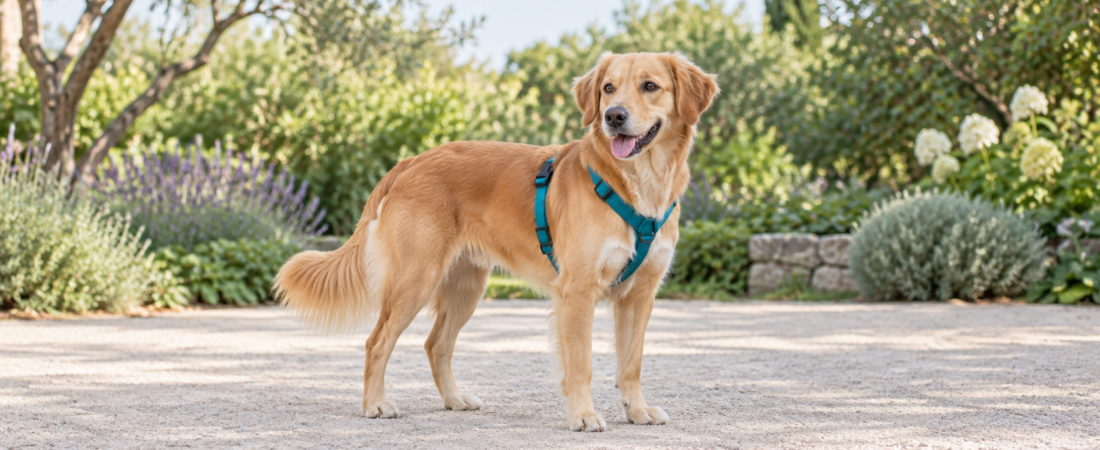
A harness can match the size chart and still slide sideways, bunch behind a front leg or feel awkward to put on. Before tightening every strap, check where the harness is meant to sit and how your dog moves in it.
A useful dog harness fit check covers size, strap placement, movement and security. Start with the instructions for your exact model, adjust it on your standing dog, then watch a short walk in a secure space. A finger-gap check alone cannot tell you whether the design suits your dog.
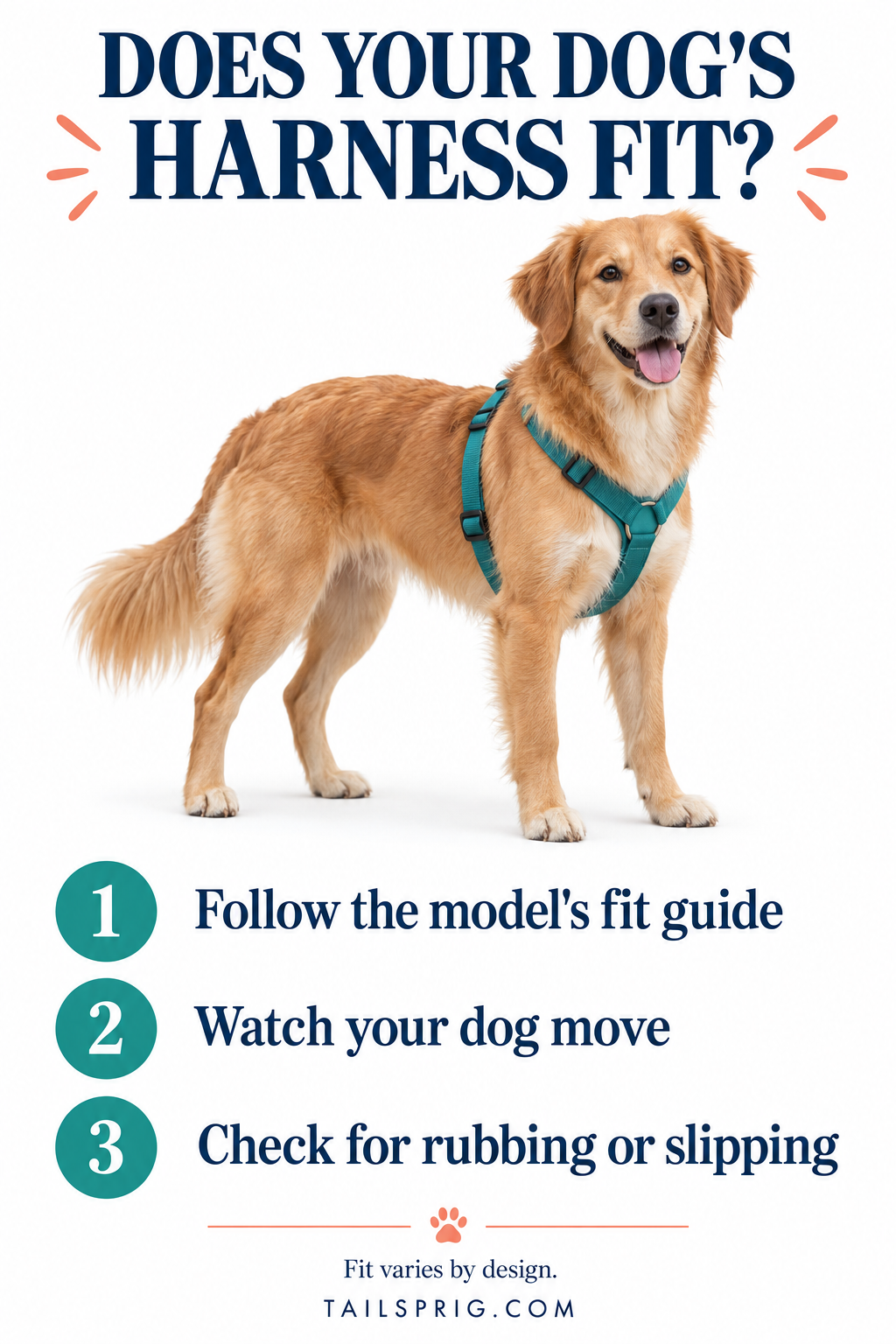
Start with the right measurements
Measure the points shown on the model’s current size chart. For example, Ruffwear’s measuring guide uses chest girth around the widest part of the ribcage for its harness sizing. Other designs may ask for additional measurements. Use a flexible tape, or measure a piece of string afterward, without squeezing the body.
Write down the measurements, date and model name. Do not transfer a size letter from another brand or choose from weight alone. If your measurements sit at a boundary, follow that manufacturer’s advice or ask its fitting team. Buying a larger harness for a puppy only helps if it fits securely now.
Lay it out before putting it on
Find the neck opening, body straps, buckles, adjusters and intended leash attachments in the product instructions. Untwist the webbing and check for worn stitching, damaged clips or slipping adjusters. If the layout is confusing, compare it with the manufacturer’s diagram while the harness is off your dog.
Adjustment systems differ. Ruffwear’s Front Range adjustment sheet, for example, shows separate shoulder and girth adjustments. That sheet applies to that harness; it is not a fitting template for every vest, step-in design or specialist pulling harness.
Check these four things on your dog
- Placement: Compare the neck and body straps with the exact model’s guide. Make sure webbing lies flat and hardware is not pinching skin or catching fur.
- Clearance: Use the manufacturer’s tightness guidance. The harness should feel secure without digging in; a general finger rule is only one part of the check.
- Movement: Watch your dog walk, turn, sit and lower their head naturally in a secure space. Look for contact behind the front legs, restriction or marked shifting.
- Condition: After the trial, remove the harness and check the contact areas for redness, rubbing or tenderness. Do not keep walking to see whether an uncomfortable fit will improve.
Dogs Trust advises choosing a harness that allows comfortable movement and checking that it is secure. Its harness introduction guide also explains gradual, reward-based practice for dogs who find wearing one unfamiliar.
Do I need one finger or two underneath?
You will find different rules because designs and fitting instructions vary. Use the guidance supplied with your particular harness, then check the whole fit while your dog moves. Being able to place fingers beneath one strap does not show whether another strap is rubbing or whether a leg can slip through.
If the guide is missing, ask the manufacturer for it. A useful message includes the exact model, your dog’s measurements and clear standing photos from the front and side. Avoid relying on a photo of a different dog in an online review as your final fitting instruction.
Why does it rub behind the front legs?
Strap position matters as well as circumference. In its Balance Harness fitting guide, Blue-9 explains that a girth strap too close to the underarm can chafe, while one too far back can press on the abdomen. Its advice is model-specific, but illustrates why “looser” is not automatically the answer.
Compare your harness with its own placement diagram. If adjusting it away from the front legs leaves the neck opening far too loose, the size or proportions may not suit your dog. Stop and seek fitting advice instead of repeatedly tightening one section to compensate for another. Do not cut, sew or improvise a load-bearing repair.
If skin is sore, stop using the harness and speak with your vet. Pain, persistent coughing or a change in gait should not be dismissed as a dog being stubborn about equipment.
What if the harness slips sideways?
Check for uneven adjustment, a twisted strap or an incorrect attachment point first. Some movement can be expected with certain designs: Blue-9 notes sideways movement with its front-attachment harness. That does not make major rotation, rubbing or a leg coming through an opening acceptable.
Use a secure indoor area for the initial trial, with gentle handling. Do not test escape resistance by dragging your dog backward or provoking a struggle. If the harness cannot stay appropriately positioned through ordinary movement, get the fit assessed before using it on an open walk.
A dog who backs out needs more than another tug on a strap
No fit checklist is an escape-proof guarantee. Dogs Trust’s escape-prevention advice recommends checking equipment and fit; for dogs who slip equipment, it also discusses a double-ended lead or suitable safety connection between collar and harness. Ask a qualified professional to help choose and fit a setup for your dog.
Address what triggers the backing away, too. A frightened dog may need more distance and a calmer environment. Our guide to reactive dogs on walks covers managing distance and practicing without forcing a close encounter.
If your dog dislikes putting it on
Separate learning to wear a harness from learning to walk outside in it. Reward calm investigation first. For an over-the-head design, let your dog approach the opening voluntarily rather than pushing it over their face. Work gradually toward fastening, wearing and moving; step back if your dog withdraws.
A neck-opening buckle may suit a dog who struggles with an over-the-head design, provided the harness fits properly. Dogs Trust describes this option in its harness-training guidance. If handling is suddenly unwelcome, or seems painful, ask your vet before treating it as a training issue.
Before the next walk
Check clips, strap adjustment and the attachment point again. Recheck fit as your dog grows or their body condition changes. A harness also does not teach loose-leash walking by itself; Dogs Trust’s loose-lead training steps use rewards and gradual practice. For quiet activities between outings, try our dog enrichment ideas at home.
The most useful question is not whether the harness looks snug in one photo. It is whether this particular harness stays securely positioned and lets your dog move comfortably throughout the walk.
This is a general fitting guide, not a product test or an individual veterinary assessment. Manufacturer links remain reference sources. As an Amazon Associate I earn from qualifying purchases. The Amazon product link below is an affiliate link. If considering the Front Range harness discussed above, use the manufacturer’s measurements to select your dog’s size; the displayed variant is not a fit recommendation for every dog.
